

Funeral flowers are tributes sent to the service; sympathy flowers are gestures of comfort sent to the family. The difference comes down to destination and timing, not the flowers themselves.
If a public service is happening, order a standing spray, wreath, or casket piece and have it delivered directly to the funeral home before the service starts. If you’re supporting the family rather than the service itself, send a vase arrangement or plant to their home, and you can do that any time, from the day of the death to two weeks later or beyond.
- Funeral home delivery: for standing sprays, wreaths, and altar pieces tied to the service itself.
- Home delivery: for vase arrangements, plants, and hand-tied bouquets meant for the grieving family.
- When in doubt: call the funeral home directly. Staff there field this question daily and can tell you what’s appropriate.
As a florist that fills both kinds of orders every week, Lafleurel builds this distinction into every consultation, because getting it wrong (a hand-held bouquet showing up at a chapel with nowhere to go, or a giant spray cluttering a small living room) creates more stress for a family that has enough of it already.
Key Takeaways
Funeral flowers go to the service before it starts; sympathy flowers go to the family’s home on any timeline that fits.
| Point | Details |
|---|---|
| Know the destination | Funeral flowers go to the service venue; sympathy flowers go to the family’s home. |
| Timing is flexible for sympathy flowers | Sending a bouquet 4 to 8 weeks after the funeral often means more than a same-week delivery. |
| Call the funeral home first | Staff confirm size limits, delivery windows, and whether flowers are being accepted at all. |
| Address the card to the family | Write “With deepest sympathy for you and your family,” not a message to the deceased. |
| Lafleurel handles both formats | Same-day delivery covers standing sprays for services and vase-ready arrangements for homes. |
Table of Contents
- Funeral Flowers: Formats, Purpose, and Delivery Rules
- Sympathy Flowers: Formats, Purpose, and Timing
- When to Choose Funeral Flowers vs Sympathy Flowers: A Quick Checklist
- Flower Types and What They Actually Communicate
- Ordering Details: What to Tell Your Florist
- What the Etiquette Rules Get Wrong
- Order Sympathy or Funeral Flowers From Lafleurel
- Frequently Asked Questions
- Sources
Funeral Flowers: Formats, Purpose, and Delivery Rules
Funeral flowers, sometimes called service flowers, are public tributes. They’re part of the ceremony itself, displayed near the casket or altar so mourners see them during the service. They’re not really for the family to keep and enjoy at home later; they’re a visible marker of respect, tied to a specific date and place.
The standard formats reflect that ceremonial role:
- Standing sprays rest on an easel near the casket and are designed to be viewed from one side only.
- Casket sprays drape directly across the casket lid, usually ordered by immediate family.
- Wreaths signal the eternal nature of life and often come from extended family or close friends.
- Altar or urn arrangements frame the space around the service itself.
Immediate family typically orders the largest pieces, while employers, coworkers, and organizations tend to send mid-size standing sprays or wreaths. Funeral flower etiquette calls for addressing the delivery to “The Family of [Name], c/o [Funeral Home Name],” with the service date and time included so staff can plan placement.
Pro Tip: Always call the funeral home before ordering a service piece. Some venues limit the number of standing sprays they can display, and staff can tell you the exact delivery window so your flowers don’t arrive after the doors open.
Sympathy Flowers: Formats, Purpose, and Timing
Sympathy flowers serve the living, not the ceremony. They’re a private gesture, meant for a kitchen counter or coffee table, not a chapel aisle. That’s why format matters differently here: a florist arranging sympathy flowers should build them “vase-ready,” already sitting in water so a grieving household doesn’t have to hunt for a container.
Common formats include:
- Vase arrangements that arrive ready to display, no extra work required.
- Hand-tied bouquets, though these still need a vase at home.
- Blooming or green plants, which last far longer than cut flowers and need only occasional watering.
Timing is more flexible than most people assume. You can send flowers the day you hear the news, or you can wait. In fact, a second delivery 4 to 8 weeks after the funeral often lands better than a same-week arrangement, because that’s when the casseroles have stopped arriving and the house has gone quiet. For a close friend or immediate family member, a generous arrangement or a substantial plant makes sense. For a coworker’s loss or a distant acquaintance, a modest bouquet communicates the same care without overstepping.
When to Choose Funeral Flowers vs Sympathy Flowers: A Quick Checklist
Run through these questions before you order anything:
- Is there a public service? If yes, a funeral-home delivery is appropriate. If the family is keeping things private, skip straight to sympathy flowers at home.
- Are you immediate family? Immediate family usually orders casket sprays or the largest standing pieces; friends and coworkers scale down.
- Are you representing a group? Workplaces and organizations often pool money for one larger standing spray rather than several small ones.
- Did the obituary request no flowers? “In lieu of flowers” means donate to the requested charity instead, though a small home arrangement for the family is still generally welcome.
Service timing has shifted enough that this checklist matters more than it used to. Rising cremation rates mean memorials are increasingly delayed or held privately weeks or months after the death, which makes a home delivery of sympathy flowers the more practical choice far more often than in past decades.
Watch for red flags too: a small venue that can’t accommodate large sprays, a household with pets where lilies could be a hazard, or a family whose cultural or religious background calls for different treatment of flowers altogether. A five-minute call to the funeral home resolves nearly all of these before you place an order.
Flower Types and What They Actually Communicate
You don’t need a botany degree to pick appropriate flowers, and the gesture itself typically carries more weight than the exact bloom you choose. Still, a few common choices have associations worth knowing.
- Lilies are widely associated with peace and the restored innocence of the soul, making them a traditional service staple.
- Roses shift meaning by color: white for reverence, red for deep love, pink for gentleness.
- Carnations symbolize devotion and hold up especially well in shipping and display.
- Chrysanthemums carry funeral associations in much of Europe and Asia, so they’re a safe, expected choice in many traditions.
- Orchids and hydrangeas work well as living plants for home delivery since both last considerably longer than cut arrangements.
For traditional services, white and soft, muted palettes remain the default. Celebration-of-life gatherings give more room for color, a nod to the person’s favorite hue or a brighter arrangement that reflects their personality. If you’re choosing a plant over cut flowers, check for pet safety first. Funeral Basics notes that true lilies are toxic to cats, so a plant is worth a second look if the household has one.
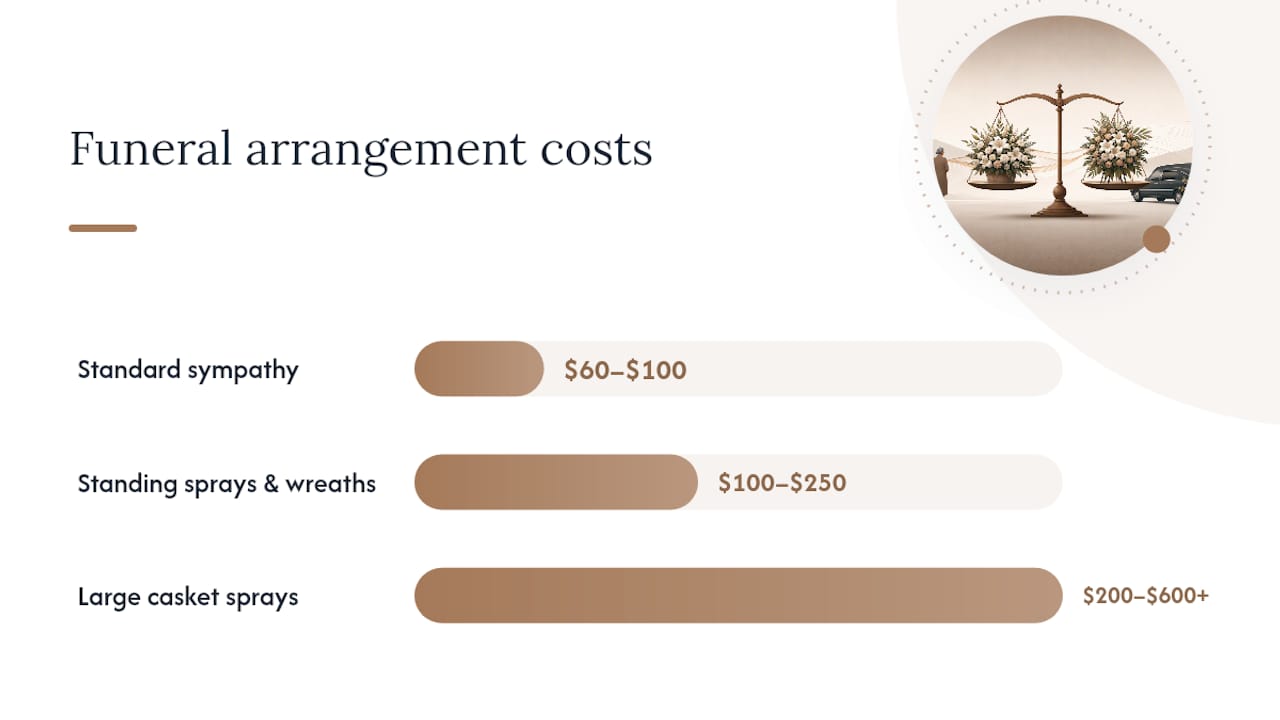
On cost, standard sympathy arrangements generally run $60 to $100, standing sprays and wreaths fall closer to $100 to $250, and larger casket sprays can run $200 to $600 or more depending on size and flower selection.
Ordering Details: What to Tell Your Florist
Give your florist these specifics up front, and the order will go smoothly:
- The destination: funeral home or family residence, with the full address.
- The deceased’s full name and the service date and time, if there is one.
- The funeral home’s name, since staff there often coordinate placement for service pieces.
- Any venue restrictions you’re aware of, like size limits or a no-flowers request.
For card wording, address the family, not the deceased: “With deepest sympathy, thinking of you and your family” works better than a message written as if to the person who died. Keep it short. Same-day delivery is standard for most home sympathy arrangements; service pieces sometimes need a day’s notice depending on size. For costlier pieces like a large casket spray, pooling funds among coworkers or extended family is a normal and accepted practice.
Pro Tip: Never carry a hand-held bouquet into the service itself. Have it delivered by the florist beforehand so staff can place it properly, and skip the awkward moment of holding flowers with nowhere to put them.
How Lafleurel Applies This in Practice
Lafleurel is a florist based in Valley Village, CA, and the etiquette above shapes how every order gets built, not just how it’s explained.
- Arrangements use locally-sourced, naturally-grown blooms, so flowers stay fresher through a service day or a week sitting on a family’s counter.
- Same-day delivery covers both destinations: a standing spray to a funeral home before a service, or a vase arrangement to a home the same afternoon.
- Design options range from classic roses to a peonies bouquet, giving both service pieces and home-friendly arrangements real variety instead of one generic “sympathy” template.
What the Etiquette Rules Get Wrong
Most guides treat sympathy and funeral flowers as a symbolism problem, listing which bloom means what. That’s the wrong starting point. The real question is logistical: where is this going, and when does it need to arrive?
Get the destination right and the flower choice mostly takes care of itself. A vase arrangement of orchids at a family’s home does more good than a symbolically perfect but impractical hand-held bouquet nobody can display. The timing advice deserves more attention than it usually gets, too. Sending flowers on the day of the funeral feels like the “correct” move, but a quiet gesture three or four weeks later, once the initial flood of support has dried up, often means more to someone still grieving.
If you take one thing from all this, make it the phone call. Calling the funeral home before you order costs five minutes and prevents almost every mistake this article covers, from wrong-size arrangements to deliveries that miss the service window entirely. Everything else is a matter of taste.
Order Sympathy or Funeral Flowers From Lafleurel
Skip the guesswork on formats and delivery windows. Lafleurel handles both funeral-home and home deliveries the same way it handles every order: handcrafted arrangements from locally-sourced, naturally-grown flowers, with same-day delivery across Valley Village and the surrounding Los Angeles area.

Whether you need a standing spray at a funeral home by a set hour or a vase-ready arrangement sent quietly to a family’s front door next month, Lafleurel builds it to fit the destination, not a generic template. Reach out through the Lafleurel site with the service details or the family’s address, and a same-day order can go out today. For a design that leans softer and more personal, browse the Quicksand Beige Roses arrangement or request a fully custom piece built around what the family or the moment calls for.
Frequently Asked Questions
Do sympathy flowers go to the funeral? No. Sympathy flowers go to the family’s home, not the service. Flowers meant for the funeral itself are called funeral or service flowers, and those get delivered to the funeral home before the service begins.
When should I send sympathy flowers instead of funeral flowers? Send sympathy flowers when there’s no public service to deliver to, when the memorial is private, or when you want to support the family after the initial rush of attention has passed. A delivery weeks after the funeral is common and often welcomed.
What’s the biggest etiquette mistake people make with funeral flowers? Bringing a hand-held bouquet into the service. Funeral flowers need to arrive through the florist before the service starts so staff can place them properly, not get carried in by a guest.
How much should I expect to spend? Standard sympathy arrangements typically run $60 to $100, standing sprays or wreaths $100 to $250, and larger casket sprays $200 to $600 or more depending on size.
What if the obituary says “in lieu of flowers”? Honor the request and donate to the organization named. A small, quiet sympathy arrangement sent to the family’s home afterward is still generally appropriate, since that request usually applies to the service, not to ongoing support.
Sources
- Funeral
- Funeral flowers: meaning and etiquette — Eulogy Expert
- 7 popular sympathy flowers & meanings — Funeral Basics