

When in doubt, send a simple white or soft-toned vase arrangement, or a long-lasting plant if you’re not sure how much attention the flowers will get. Confirm delivery instructions with the funeral home or family first, and write the deceased’s full name plus the service date clearly on the card. That single move, more than any flower choice, is what actually helps.
TL;DR:
- Sending plants like orchids or peace lilies is ideal for recipients who may not tend daily vase arrangements, as they last longer and require less care.
- Large, formal tributes such as standing sprays are expected at funeral homes, while smaller vase arrangements or potted plants suit home deliveries better.
- White flowers remain the safest choice for sympathy, but softer tones like pink, purple, or peach can convey tenderness, respect, and hope depending on the occasion.
- Avoid lilies if the household has cats and refrain from strongly fragrant blooms like hyacinths in enclosed spaces or hospitals.
- Including the deceased’s full name and service date on the card is crucial, and flowers sent weeks later can still offer meaningful support.
Table of Contents
- Sympathy Flowers Guide: Common Types and What They Mean
- What Do Flower Colors Mean for Sympathy?
- Where Should You Send Sympathy Flowers, and When?
- How Much Should You Spend, and What Size Fits Your Relationship?
- What Should You Write on a Sympathy Card?
- Florist Notes: How La Fleurel Handles Sympathy Arrangements
- Craft Meets Compassion
- Order Sympathy Flowers Through La Fleurel
- Sources
- FAQ
Sympathy Flowers Guide: Common Types and What They Mean
Every flower on a sympathy order form carries some inherited meaning, but you don’t need a botany degree to choose well. What matters more is longevity, scent, and whether the arrangement fits the destination. Here’s what to know about the twelve blooms you’ll see most often on any sympathy flower arrangements menu.
- Lilies. The traditional funeral flower, symbolizing peace and the restored innocence of the soul. They hold up for a week or more, which makes them a strong pick for home delivery. One caution worth repeating: true lilies (Asiatic, Stargazer, Easter varieties) are highly toxic to cats and should be skipped entirely if the household has one.
- Roses. White roses read as reverence and remembrance; soft pink suggests grace and gentleness. They’re versatile enough for a service or a home, though fully open blooms fade faster than buds.
- Carnations. Underrated for sympathy work. They last two weeks or longer in water, which makes them a practical choice when nobody’s home to change the vase daily.
- Chrysanthemums. In much of Europe, “mums” are the default funeral flower, tied directly to remembrance. They’re also one of the longest lasting cut flowers available, often holding color for ten days or more.
- Orchids. Elegant, sturdy, and low maintenance as potted plants. A phalaenopsis orchid can bloom for months with almost no care, which makes it a smart alternative when you want something that outlasts the week.
- Hydrangeas. Full, soft, and calming visually. They droop quickly if the water level drops, so they’re better suited to a monitored home setting than an unattended venue.
- Gladioli. Tall, structural stems often used in standing sprays and casket arrangements because of their height and formal look. Not ideal for a small vase on a kitchen counter.
- Irises. Symbolize hope and faith in many traditions, with a deep purple or blue tone that reads as dignified rather than festive.
- Daffodils. A spring flower associated with new beginnings, gentler and more hopeful in tone. Better suited to a service celebrating a long life than an unexpected loss.
- Hyacinths. Fragrant and often linked to sorrow and forgiveness in floral tradition. The scent is strong, so they’re a poor choice for hospital rooms or small enclosed spaces.
- Lily of the valley. Delicate white bells symbolizing the return of happiness. Their bloom window is short, closer to five or six days, so they work best when flowers will be seen and enjoyed quickly.
- Forget-me-nots. Exactly what the name promises: remembrance and enduring connection. Often mixed into larger arrangements rather than sent alone.
A quick care note worth passing along: fresh water and a trimmed stem every two to three days will extend almost any cut arrangement by several days. Choosing long-lasting stems and avoiding heavily fragrant blooms in enclosed spaces is one of the simplest ways to make sure your gift is still doing its job a week later.
What Do Flower Colors Mean for Sympathy?
White is the safest default in sympathy flower etiquette, and it’s safe for a reason: it reads as purity and peace across nearly every cultural and religious tradition, so it rarely clashes with a family’s expectations. Soft neutral palettes remain the most traditional and lowest-risk choice when you don’t know the family well.
Beyond white, color shifts the tone of the message:
- Pastel pink or peach signals tenderness and gratitude, well suited to a close friend or a parent’s service.
- Purple and lavender carry dignity and respect, often chosen for a colleague or someone you knew more formally.
- Yellow leans toward friendship and, in some settings, celebration of a life well lived, but it can feel out of place at a somber, traditional service if you don’t know the family’s preference.
- Deep red suggests deep love and is generally reserved for immediate family rather than acquaintances.
Pro Tip: If you’re torn between two palettes, pick the more conservative one for a religious or formal service, and save brighter, celebratory tones for a “celebration of life” gathering where the invitation or obituary signals a lighter tone.
For a traditional funeral, stick with white, cream, or soft green. For a celebration of life, a mix of white with one accent color, like soft yellow or peach, tends to land well without overwhelming the room.
Where Should You Send Sympathy Flowers, and When?
The destination changes everything about what you should send. Funeral homes and places of worship typically expect larger, formal tributes like standing sprays or wreaths, timed to arrive before the service starts so staff can place them. Home deliveries call for something smaller and more personal, a vase arrangement or a potted plant that the family can actually live with in the weeks after. Hospitals are their own category entirely: compact, low-fragrance arrangements only, since strong scents and pollen aren’t welcome in patient rooms.
Before you order anything, run through this short checklist:
- Check the obituary or the funeral home’s website for specific delivery instructions or timing windows.
- Call the funeral home directly if you’re unsure whether they accept walk-in deliveries or only pre-scheduled ones.
- Confirm the exact address, since services and visitations are sometimes held at a different location than the burial.
- Write the deceased’s full name and the service date on the delivery card so staff can place the arrangement correctly and log it for the family’s thank-you notes.
- If sending to a private home, ask whether anyone will be there to receive and water the arrangement, or default to a plant instead.
That last point matters more than people think. A gorgeous arrangement left on a porch in the sun for six hours is a wasted gesture. A sturdy vase arrangement built for home delivery solves that problem by holding water longer and tolerating a few unattended hours far better than a loose bouquet.
How Much Should You Spend, and What Size Fits Your Relationship?
Relationship, not budget, should drive the scale of what you send. Immediate family and very close friends often go bigger, sometimes a standing spray or a large arrangement for the service itself. Coworkers, acquaintances, and casual friends usually do better with a modest bouquet or a plant sent to the home, which reads as sincere without feeling like it’s competing for attention with family tributes.
- Immediate family or best friends: a large arrangement or standing spray, either alone or split among siblings.
- Close friends or extended family: a mid-size vase arrangement or a substantial bouquet.
- Coworkers or acquaintances: a modest bouquet, a plant, or a pooled office arrangement.
- Group or office gifts: pooling money for one larger tribute often makes more visual and financial sense than five small bouquets arriving separately.
If the obituary specifically requests donations “in lieu of flowers,” that’s a clear signal the family prefers charitable gifts over floral tributes as the main gesture. A small, private arrangement sent to the home afterward is usually still fine as a separate, personal touch, just not as a substitute for honoring the request publicly. When flowers aren’t quite right, a potted orchid, a peace lily, or a rosemary plant makes a lasting alternative that doesn’t need daily care.
What Should You Write on a Sympathy Card?
The card is where most people freeze up, and honestly, it matters more than the flower choice. A short, sincere line beats a long one every time.
- For immediate family: “Thinking of you and your family during this difficult time. Sending love.”
- For a close friend: “I’ll always remember [name]'s laugh. I’m here whenever you need me.”
- For a coworker’s loss: “Our thoughts are with you. Please let us know if there’s anything the team can do.”
- For a group card: “With deepest sympathy from all of us at [company/group name].”
- For someone you don’t know well: “With sincere condolences on your loss.”
- Faith-based option: pairing a short note with a comforting scripture verse about grief can feel appropriate for families with strong religious ties.
Skip platitudes like “everything happens for a reason,” and never ask the family to respond, this isn’t a gesture that needs acknowledgment. Signing anonymously is fine if that’s more comfortable, though a name helps the family track who to thank later. And there’s no real deadline: flowers sent weeks or even months after the funeral can land harder, precisely because that’s when the early wave of support has faded.
Florist Notes: How La Fleurel Handles Sympathy Arrangements
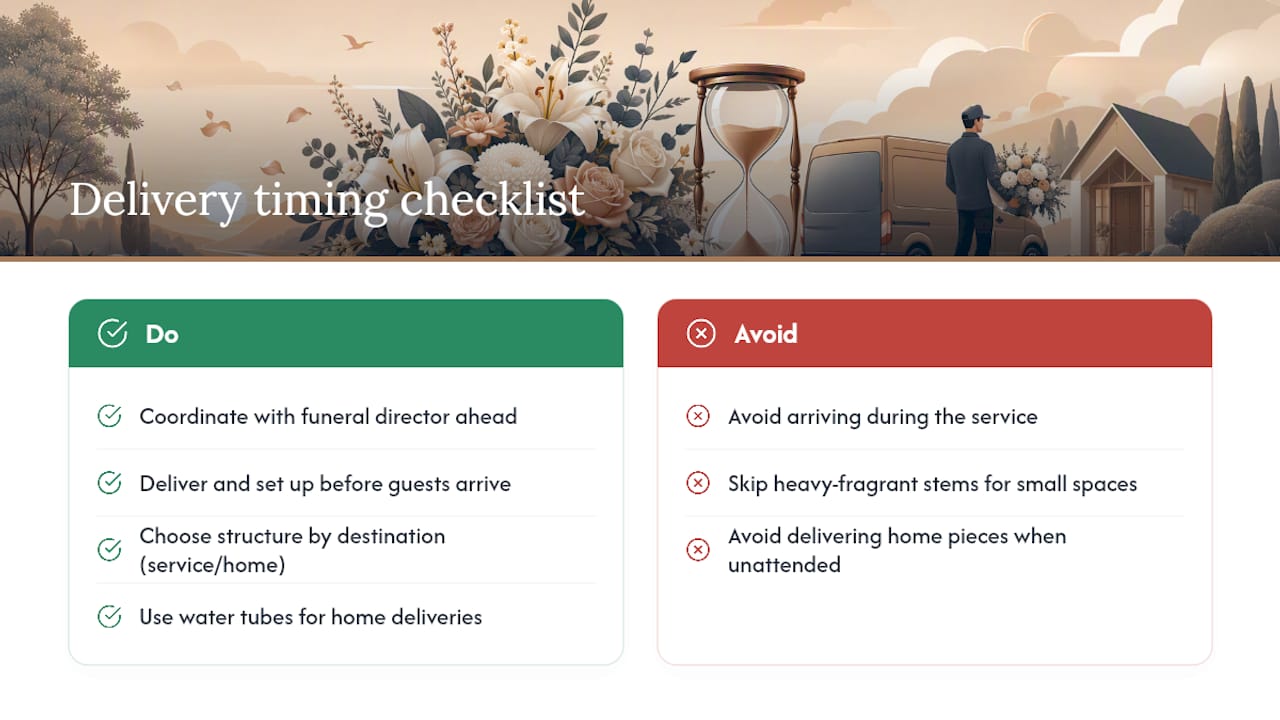
Selecting stems with conditioning and floral preservatives in mind is standard practice for extending vase life, but the bigger decision happens before a single flower gets cut: is this going to a service or a home? Service pieces need structure, tall stems, dense foliage, and a stable base that won’t tip during setup or transport. Home pieces need the opposite: a low, sturdy vase, water tubes where needed, and stems chosen to survive a few unattended hours if nobody’s there to greet the delivery.
Delivery timing matters just as much as the arrangement itself. Coordinating with the funeral director ahead of the service, rather than showing up during it, keeps the family’s day from getting more complicated than it already is.
Pro Tip: Ask your florist to skip heavily fragrant stems like hyacinth or Oriental lilies if the arrangement is headed to a small home or a shared office space. Scent lingers longer than color.
Craft Meets Compassion
Choosing sympathy flowers isn’t really about mastering symbolism, it’s about walking through three questions in order: where is this going, how close were you to the person who died, and what tone fits the room. Get those three right and the rest sorts itself out. Perfect flower selection has never comforted anyone; a sincere card and a thoughtful delivery time have.
— Ovannes
Order Sympathy Flowers Through La Fleurel
Sympathy arrangements are handcrafted with locally sourced, naturally grown blooms, and same-day delivery is offered, which matters when a service is tomorrow morning and you’re still deciding what to send.

For a funeral home delivery, order early enough to reach the venue before the service, and note the deceased’s full name and service date in the order instructions so staff can place it correctly. For a home delivery, a soft, neutral vase arrangement or the understated tones of a beige rose design both hold up well without daily attention. If the service calls for something larger and more formal, the Pure Elegance arrangement is built with that scale in mind. Need something specific, like pet-safe stems or a particular palette? Request a custom arrangement and describe exactly what the moment calls for.
Sources
FAQ
What Is the Etiquette for Sending Sympathy Flowers?
Coordinate with the funeral home if flowers are going to a service, choose a smaller vase arrangement or plant for a home delivery, and always include the deceased’s full name and the service date on the card.
Is It Rude to Send Flowers Weeks After a Funeral?
No. Sending flowers weeks or even months later is still meaningful, and it can mean more once the initial wave of support has faded.
What Flowers Should You Avoid for Sympathy?
Avoid true lilies if the recipient’s household has cats, since they’re highly toxic, and skip heavily fragrant blooms like hyacinth for hospital rooms or small enclosed spaces.
What Should You Do if the Obituary Says “In Lieu of Flowers”?
Follow that request as the main gesture and consider a donation instead; a small, private arrangement sent later to the home is still an acceptable separate gesture.
How Do You Choose Between a Bouquet and a Plant?
Choose a plant, like an orchid or peace lily, when nobody will be home to tend a vase daily, and choose a cut arrangement when the recipient will see and enjoy it within the first week.