

Pick a local florist for weddings, funerals, hospital visits, or anything you need delivered within hours, and pick online delivery for long-distance gifts or quick, low-cost bouquets when timing isn’t tight. The dividing lines are freshness, customization, same-day speed, and cost per stem. Wirecutter’s testing backs this up: local shops routinely sidestep the shipping problems that plague online orders, while shops like Lafleurel in Valley Village, CA show what that reliability looks like on the ground.
TL;DR:
- Local florists deliver fresher arrangements because flowers are cut and conditioned on-site, often the same day they are delivered.
- For high-stakes occasions like weddings and funerals, personalized in-person service and exact timing are best handled by local shops.
- Online flower services vary: aggregators and farm-direct shippers carry risks of damage, substitution, and reduced freshness, especially for delicate flowers.
- Shipping costs and service fees often increase the final price by 20 to 30 percent, making local shops more cost-effective within the $60 to $90 budget range.
- Choosing a local florist with direct communication, clear policies, and quick responsiveness is essential for reliable, high-quality floral delivery.
Table of Contents
- How Do Online Flower Services Actually Work?
- Benefits of Ordering From a Local Florist
- When Should You Choose a Local Florist?
- Freshness and Quality: What to Expect and How to Judge
- Cost and Value: Reading Past the Sticker Price
- How to Choose: A Quick Checklist
- Lafleurel: How a Local Florist Operates in Practice
- Return and Refund Policies
- Customer Service Responsiveness and Problem Resolution
- Author Perspective: Quick Rules of Thumb
- Want Local Service Right Now? Here’s a Direct Option
- Sources
- FAQ
How Do Online Flower Services Actually Work?
Not all “online florists” work the same way, and that gap explains most of the horror stories you’ve heard about wilted bouquets showing up on someone’s doorstep.
Three models dominate the market:
- Aggregators take your order and forward it to a random local shop in that zip code, often taking a cut before the florist ever sees your money.
- Farm-direct shippers grow or source flowers centrally, then box and ship them straight to the recipient, skipping local shops entirely.
- Local-fulfilled platforms are essentially a local florist’s own website, so the order goes directly to the person building your arrangement.
Shipped flowers face real risks: box damage, temperature swings, and substitution when a listed variety isn’t available. Wirecutter found only a handful of online services consistently clear the bar, with quality swinging based on season and route. To spot the model before you buy, check for a fulfillment disclosure in the checkout fine print, look for “farm-direct” language in the product description, and try calling the phone number listed. If it rings through to voicemail with no local area code, you’re likely dealing with an aggregator.
Benefits of Ordering From a Local Florist
A local florist cuts, conditions, and arranges flowers on-site, often the same day they’re delivered. That short window between cutting and delivery is the single biggest reason arrangements from a shop tend to outlast anything shipped in a box.
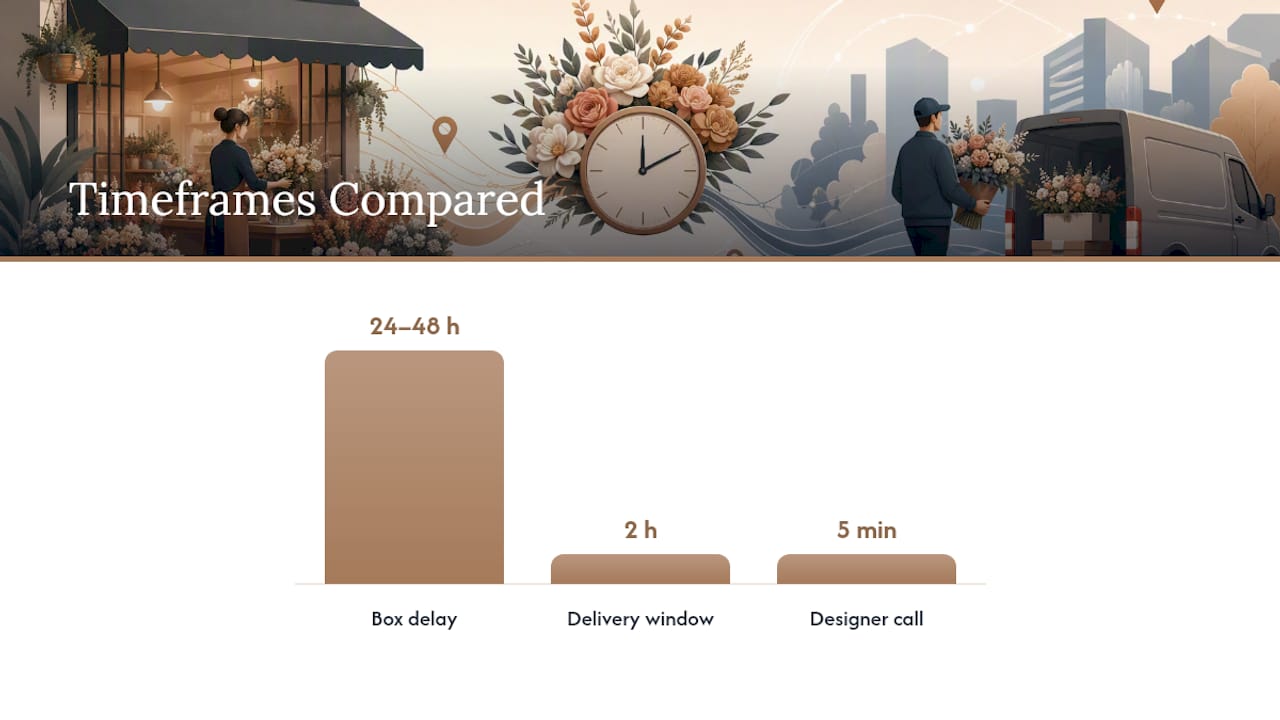
- Freshness: Stems get hydrated and conditioned in-store, not sealed in cardboard for 24 to 48 hours.
- Customization: You can call and ask for more white, fewer lilies, or a taller arrangement, and talk directly to the person making it.
- Same-day precision: A local shop can hit a 2-hour hospital delivery window or a funeral home’s exact drop-off time.
- Transparent pricing: What you pay largely goes to flowers and labor, not a middleman’s service fee.
- Community impact: Buying local keeps money in your city and, per research from Washington University in St. Louis, cuts the transportation emissions tied to shipping flowers cross-country.
Professional florists also tend to build a personal relationship with the arrangement itself. University of Minnesota Horticulture notes that direct communication between customer and designer produces work that feels considered, not assembly-line.
Pro Tip: Call the shop instead of using its online order form when you have specific requests. A five-minute conversation with the designer gets you a far more accurate result than a text box on a checkout page.
When Should You Choose a Local Florist?
Match the occasion to the delivery method, and most of the guesswork disappears.
- Weddings and major anniversaries. These need color matching, exact quantities, and setup coordination that only a local designer can pull off in person. Industry guidance consistently points toward calling a shop directly for events like these rather than trusting a generic online template, according to University of Minnesota Horticulture.
- Funerals and sympathy arrangements. Timing is fixed, the tone has to be right, and there’s no room for a substituted flower showing up in the wrong shade.
- Same-day or narrow-window deliveries. Hospital visits, last-minute birthdays, and apology bouquets all depend on a shop that can turn an order around in hours, not days.
- Long-distance gifts or budget-driven sends. This is where online delivery earns its place. Mitigate the risk by choosing a local-fulfilled platform in the recipient’s city rather than a shipped box, especially around demand spikes. SAF data on Mother’s Day shows how strained supply gets during peak floral holidays, straining both online platforms and local shops alike.
Freshness and Quality: What to Expect and How to Judge
A local shop typically delivers flowers within hours of cutting and conditioning them. A shipped bouquet, by contrast, often spends one or more days in transit between the farm and your door, even under refrigeration.
Packaging matters more than people realize. Boxed stems get compressed, buds close up during transit, and rehydration after unboxing doesn’t always fully restore vase life. Some flowers hold up fine. Others don’t.
- Shipping-tolerant: carnations, alstroemeria, and most standard roses travel reasonably well.
- Shipping-sensitive: peonies, hydrangeas, and ranunculus bruise easily and open unevenly after time in a box.
Wirecutter’s review testing found that a small group of farm-direct services can approach local freshness, but variability across seasons and shipping routes remains high. If you’re ordering peonies for someone, a locally handled peony bouquet avoids that gamble entirely. When shopping online, look for real photos of current stock, not stock photography, and read the fulfillment notes for any mention of cold-chain shipping.
Cost and Value: Reading Past the Sticker Price
A $60 arrangement online rarely costs $60 by the time it reaches the recipient. Service fees, handling charges, and delivery costs stack on top of the advertised price, sometimes adding 20 to 30 percent before tax.
- Service fees: charged per order, often not shown until the final checkout screen.
- Delivery fees: separate from service fees, and higher for rural zip codes.
- Handling charges: a smaller line item, but it adds up alongside everything else.
A local shop’s $75 arrangement usually puts more of that money into actual stems, since there’s no platform taking a cut. Mayfield Flower Company’s analysis found local fulfillment tends to deliver better value in the mid-range budget, roughly $60 to $90, because less of the ticket price gets absorbed by fees. Online can still win on price during a sitewide promo or through a membership discount, but compare the full checkout total, not the number on the homepage, before deciding.
How to Choose: A Quick Checklist
Run through this before placing any order over $50, or any order tied to a specific date.
- Confirm the delivery window in writing, especially for same-day or timed drop-offs.
- Ask what happens if a specific flower is out of stock, and get the substitution policy in plain language.
- Request a recent photo of in-stock stems if you’re ordering something delicate like peonies or ranunculus.
- Check for a real local phone number and a named contact, not just a chat bot.
- Look for recent reviews mentioning the actual shop location, not just the ordering platform.
Red flags: no listed local address, vague phrases like “similar substitution,” and fees that only appear at the final checkout step.
Pro Tip: Ask directly, “Who is arranging this, and where?” A shop with nothing to hide will answer in one sentence.
Lafleurel: How a Local Florist Operates in Practice
This local florist operates by building each arrangement from locally sourced, naturally grown blooms rather than shipped stock.
- Same-day delivery across Valley Village and the surrounding Los Angeles area, so hospital and last-minute orders aren’t left guessing.
- On-site conditioning before delivery, following the same cut-to-door logic that keeps arrangements fresh longer.
- Direct custom requests honored through consultation, whether that’s a custom arrangement for a wedding or specific color notes for a sympathy piece.
Many customers mention the longevity and presentation of the arrangements, a pattern that lines up with what local sourcing and hands-on design tend to produce.
Return and Refund Policies
Return policies split sharply between local shops and online platforms, and that split matters more than most people expect until something goes wrong.
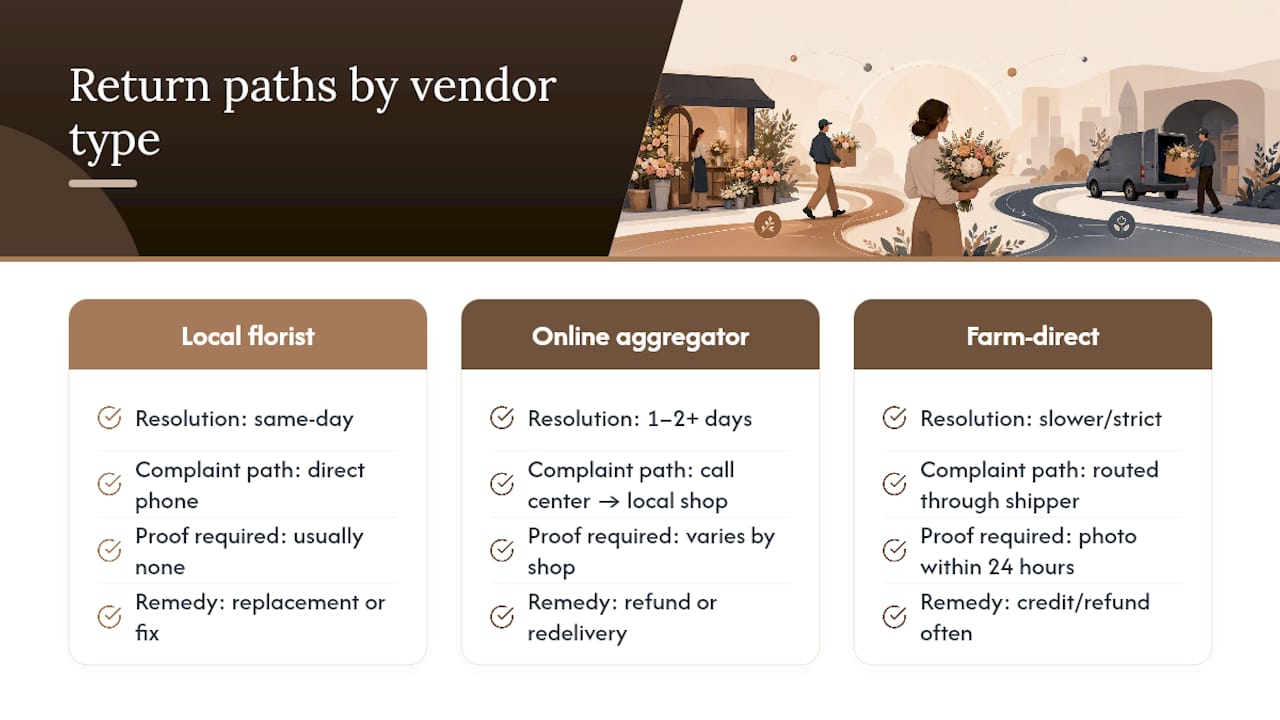
A local florist can usually resolve a problem the same day. If an arrangement arrives wilted or doesn’t match what was ordered, a phone call often gets a replacement out that afternoon, since the person who made the mistake is the same person who can fix it. There’s no support ticket queue standing between the complaint and the solution.
Online aggregators work differently. Your complaint often routes through a call center that has to contact the local shop that actually fulfilled the order, then wait for that shop’s response before issuing a refund or redelivery. That chain adds a day or two, sometimes more during peak holidays when everyone is filing the same complaint.
Farm-direct shippers tend to have the strictest policies, frequently requiring a photo of the damaged box within a narrow window, like 24 hours of delivery, before they’ll issue any credit. Read the return policy before you buy, not after something goes wrong. Look specifically for how long you have to report an issue, whether the remedy is a refund or a replacement, and whether replacements come with a new delivery fee attached. A policy that’s vague on any of these three points is a policy that will frustrate you later.
Customer Service Responsiveness and Problem Resolution
Response time separates a good florist experience from a bad one faster than almost any other factor, and it’s the one thing you can’t fully judge until you actually need help.
Local shops tend to win here simply because of scale. A shop handling dozens of orders a day can pick up the phone and make a judgment call on the spot, whether that’s swapping a flower, adjusting a delivery time, or rushing a replacement across town. You’re talking to someone who can see the flowers in front of them.
Larger online platforms handle thousands of orders daily across multiple time zones, which means your issue gets triaged by a support system before a person weighs in. That’s not necessarily worse, but it’s slower, and it often depends on which local shop actually filled your order behind the scenes. Mayfield Flower Company’s research found consumer satisfaction runs consistently higher with local fulfillment compared to large aggregator networks across many mid-sized US cities, and slow issue resolution is a common reason cited.
Before you order anywhere, test their responsiveness in a low-stakes way. Send a question through their contact form or call the listed number. If it takes more than a day to hear back before you’ve even spent money, that’s a preview of what happens if your order goes sideways on a day that actually matters, like a funeral or a wedding morning.
Author Perspective: Quick Rules of Thumb
If it’s high-stakes, same-day, or needs a personal touch, go local. If it’s long-distance, low-cost, or purely convenience-driven, online works fine. When in doubt, run it through the checklist above and just call a local shop.
— Ovannes
Want Local Service Right Now? Here’s a Direct Option
This florist offers an alternative to guessing whether an online order will show up fresh. Every arrangement is handcrafted from locally sourced, naturally grown flowers, with same-day delivery available within their service area, so you skip the shipping-box gamble entirely.

Whether you need a romantic garden arrangement with peonies for an anniversary or a fully custom design for a wedding or memorial, Lafleurel’s designers work directly with you on color, size, and timing. If your occasion falls into any of the high-stakes categories covered above, visit Lafleurel’s Valley Village shop online to check same-day availability and place your order today.
Sources
- The Best Online Flower Delivery Service | Wirecutter
- Local cut flower production news | University of Minnesota Horticulture
- Sustainable flowers | Washington University in St. Louis
- Mother’s Day floral statistics | SAF (Society of American Florists)
FAQ
Is It Better to Order From a Local Florist or Online?
For weddings, funerals, and same-day needs, a local florist is usually the better choice because of freshness, customization, and direct communication. For long-distance gifts or low-cost sends where timing is flexible, online delivery works fine.
What Is the 3-5-8 Rule for Florists?
Definitions of this rule vary by shop and region, and there’s no single industry-wide standard, so ask your local florist directly what pricing or design formula they use rather than assuming a fixed rule applies everywhere.
Is It Cheaper to Call a Local Florist?
Often, yes. Local florists typically put more of your payment toward flowers and labor rather than platform service fees, which Mayfield Flower Company’s analysis found delivers better value in the $60 to $90 range compared to many online checkouts.
Where’s the Best Place to Buy Flowers Online?
The best online option depends on whether the service is farm-direct or local-fulfilled; look for real fulfillment disclosures and local phone numbers, or choose a locally based shop like Lafleurel that handles delivery directly rather than through a shipping network.