

A corsage is a small floral piece worn by women, usually on the wrist or pinned near the shoulder. A boutonniere is a single flower or tiny cluster worn by men in the jacket lapel. That’s the whole distinction in one sentence, and everything else in this guide just fills in the practical details.
- Placement: wrist or dress for corsages; left lapel for boutonnieres
- Scale: corsages are small clusters, boutonnieres are usually one focal bloom plus greenery
- Occasions: weddings, proms, homecoming, and milestone family events
According to Merriam-Webster, a corsage is defined as a small bouquet worn on a dress or jacket, while Brides confirms the traditional split: women wear corsages, men wear boutonnieres, and Lafleurel builds both to match the same event palette.
Key Takeaways
The core difference between a corsage and a boutonniere is who wears it and where: corsages go on women’s wrists or dresses, boutonnieres go on men’s lapels.
| Point | Details |
|---|---|
| Core difference | Corsages are worn by women on the wrist or dress; boutonnieres are worn by men on the left lapel. |
| Check the lapel first | Confirm a functional buttonhole exists before pinning; use a magnetic back if it doesn’t. |
| Pin right before the event | Refrigerate flowers until 30 to 60 minutes before wear to keep them photo-ready. |
| Order two to three weeks ahead | Give florists lead time for weddings with ten or more matched pieces. |
| Lafleurel builds matched sets | Custom corsage and boutonniere pairs with same-day delivery across Valley Village and nearby LA. |
Table of Contents
- Corsage vs Boutonniere at a Glance
- When Do You Wear a Corsage or Boutonniere?
- How to Attach a Corsage or Boutonniere Correctly
- Who Gets a Corsage or Boutonniere at a Wedding or Prom
- Popular Styles and Flower Choices for Each
- When to Order and What to Expect to Pay
- Keeping Flowers Fresh and Preserving Them Afterward
- Florist Pro Tips for a Smooth Wedding or Prom Day
- A Florist’s View on Getting This Right
- Let Lafleurel Handle Your Corsage and Boutonniere Set
- Frequently Asked Questions
- Sources
Corsage vs Boutonniere at a Glance
Here’s the fast version, if you’re standing in a florist shop with fifteen minutes before pickup.
- Corsage: worn by women, wrist or pinned to a dress/jacket, one to three blooms, styles include wrist corsage or pin-on corsage
- Boutonniere: worn by men, left lapel, typically a single bloom with greenery, occasionally two small blooms
- Bride party: bridesmaids often skip corsages in favor of holding bouquets; mothers and grandmothers usually get one
- Groomsmen and dads: boutonnieres, matched to the groom’s but slightly smaller in scale
Modern couples increasingly treat “matching” as a loose guideline rather than a rule. Coordinating color rather than using identical flowers looks more intentional in photos anyway.
When Do You Wear a Corsage or Boutonniere?
Weddings put boutonnieres on the groom, groomsmen, fathers, and often the officiant, while corsages go to mothers, grandmothers, and sometimes the flower girl in a wrist-safe mini version. Proms and homecoming dances lean more flexible: many attendees now order a corsage and a boutonniere as a matched pair regardless of who’s traditionally “supposed” to wear which, and florists increasingly emphasize inclusivity over rigid gender rules so every date feels honored in the same aesthetic.
- Weddings: boutonnieres for groom’s side, corsages for mothers/grandmothers
- Prom and homecoming: paired sets, style often driven by dress color
- Father-daughter dances: boutonnieres for dads, wrist corsages for daughters
- Milestone events: anniversaries, retirement parties, and galas use single boutonnieres for honorees
Heat and humidity shorten a flower’s life fast, so a June wedding or an outdoor prom photo session calls for sturdier blooms like spray roses or orchids over anything fragile like sweet peas.
How to Attach a Corsage or Boutonniere Correctly
Getting this wrong usually means a crushed bloom or a small hole in an expensive jacket. Here’s the sequence that avoids both.
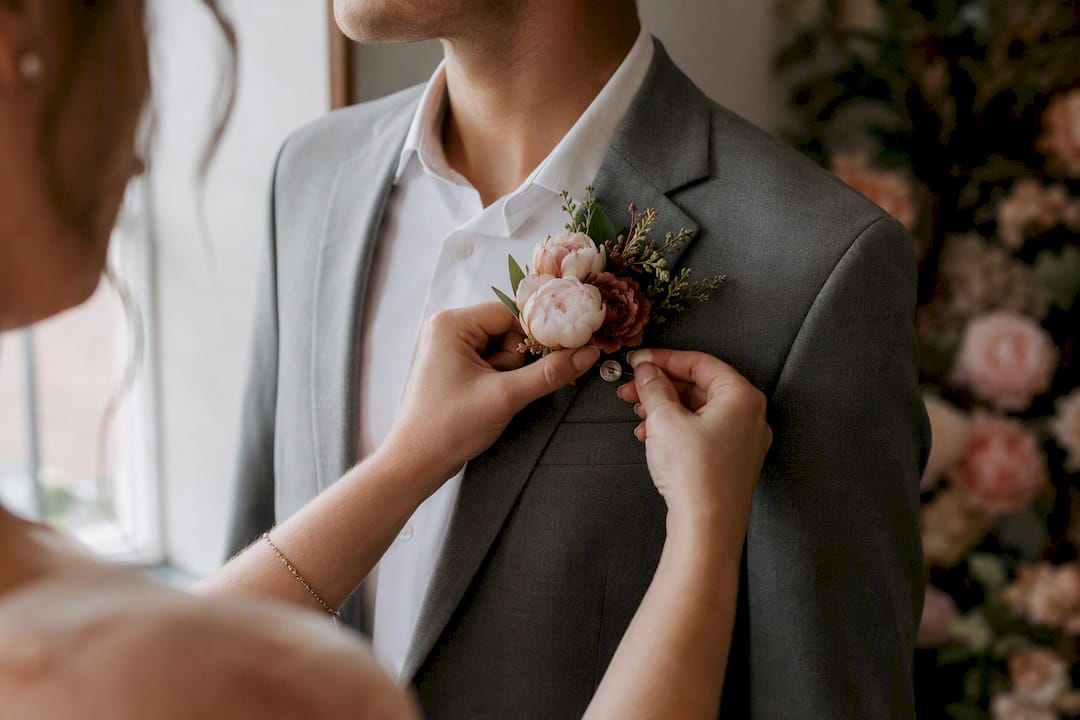
- Check the lapel first. Look for a functional buttonhole or a thread loop on the underside of the lapel. Many modern jackets, especially rentals, don’t have one.
- Pin at an angle. Insert the pin through the stem, angled slightly downward through the fabric, then back up through the lapel facing so the pin head sits hidden underneath.
- Secure wrist corsages with the elastic band snug but not tight. Check circulation after ten minutes; wrists swell slightly in warm rooms.
- For pin-on corsages, anchor through a seam or lined section of fabric, never through thin silk or chiffon alone.
- Wait until right before photos or the ceremony line to pin everything. Stems dry out and petals bruise faster once removed from water or a cooler.
When the lapel lacks a proper buttonhole, florists commonly switch to a magnetic backing instead of forcing a pin through delicate wool or a rented tux.
Pro Tip: Keep two extra magnetic backs and a spare pin in your reception day-of kit. Someone’s boutonniere will fall off during the first dance, guaranteed.
Who Gets a Corsage or Boutonniere at a Wedding or Prom
Order for these people, then add two or three extras for anyone you forgot:
- Bride’s mother and groom’s mother: corsages, often coordinated but not identical
- Grandmothers: simplified corsage version, smaller scale
- Groom, groomsmen, and fathers: matching boutonnieres
- Officiant and ushers: a single boutonniere each, usually smaller than the groom’s
- Ring bearer: a mini boutonniere sized for a child’s lapel
- Prom dates: one corsage and one boutonniere per couple, sometimes ordered as a set
Traditionally, the male date bought the corsage and the female date bought the boutonniere, but that expectation has largely faded, and most couples now split the order or have a parent handle it through the florist directly.
Popular Styles and Flower Choices for Each
A corsage can be built from fresh or dried flowers and usually leans toward two or three coordinated blooms, while a boutonniere is typically a single focal flower with greenery tucked behind it for structure.
- Wrist corsage: compact cluster on an elastic or ribbon band, most common for prom
- Pin-on corsage: attaches directly to a dress strap or jacket, favored for mothers
- Nosegay-style corsage: a tiny round bouquet, popular for vintage-themed weddings
- Single-bloom boutonniere: one rose, ranunculus, or spray rose with greenery
- Spray-style boutonniere: two or three smaller blooms for a fuller look
Roses and spray roses hold up well through a full evening. Carnations last even longer and cost less, which is why they show up so often at proms. Orchids look striking but bruise if handled roughly. Greenery like eucalyptus or ruscus fills gaps and adds scent without adding bulk. For warm-weather events, swap anything delicate (garden roses, sweet peas) for sturdier blooms, and consider a coordinated rose arrangement as a visual anchor for the whole wedding party’s palette.
When to Order and What to Expect to Pay
Corsages typically run less than a full boutonniere set once you factor in labor and wire work, though exact pricing depends heavily on flower choice and season. Order at least two to three weeks ahead for weddings with ten or more pieces, since custom color matching takes time to source. Prom orders can often be placed with just a few days’ notice, and many florists, Lafleurel included, offer same-day pickup for smaller quantities when flowers are in stock.
- Confirm your color palette and dress/tie swatches before ordering
- Count every recipient, then add two spares for accidents
- Specify pin-on, wrist, or magnetic attachment when you order
- Ask about same-day availability if you’re ordering fewer than five pieces
Rush orders during peak prom weekends in spring can mean limited flower selection, so locking in your order early still beats waiting for a same-day miracle.
Keeping Flowers Fresh and Preserving Them Afterward
Store corsages and boutonnieres in the refrigerator until the last possible moment, ideally pinned on only right before the receiving line or photos start. Keep stems misted or wrapped in a damp paper towel if there’s a gap between pickup and the event.
- Refrigerate until 30 to 60 minutes before wear
- Avoid direct sunlight or a hot car trunk, even for a short drive
- Remove gently by unclipping the pin backward, not pulling from the fabric
- Blot, don’t wipe, if pollen or petal residue touches clothing
For keepsakes, drying or pressing a corsage works well for roses and spray roses but poorly for anything with thin, high-moisture petals like orchids. Professional resin preservation costs more but keeps color truer than air-drying at home.
Florist Pro Tips for a Smooth Wedding or Prom Day
- Test the lapel before the day arrives. Rental tuxes rarely have a working buttonhole.
- Carry a mini repair kit: floral tape, extra pins, and one magnetic back per person wearing a boutonniere.
- Order corsages with a slightly shorter ribbon than you think you need; wrists shrink less than you’d expect once nerves and adrenaline hit.
- If a bloom falls off mid-event, floral tape and a spare greenery sprig can patch it in under a minute.
Lafleurel builds matched corsage and boutonniere sets through a quick consultation, so color coordination isn’t guesswork on your end.
Pro Tip: Check every boutonniere lapel again right before the ceremony line forms. Jackets shift during the getting-ready hours, and pins loosen.
A Florist’s View on Getting This Right
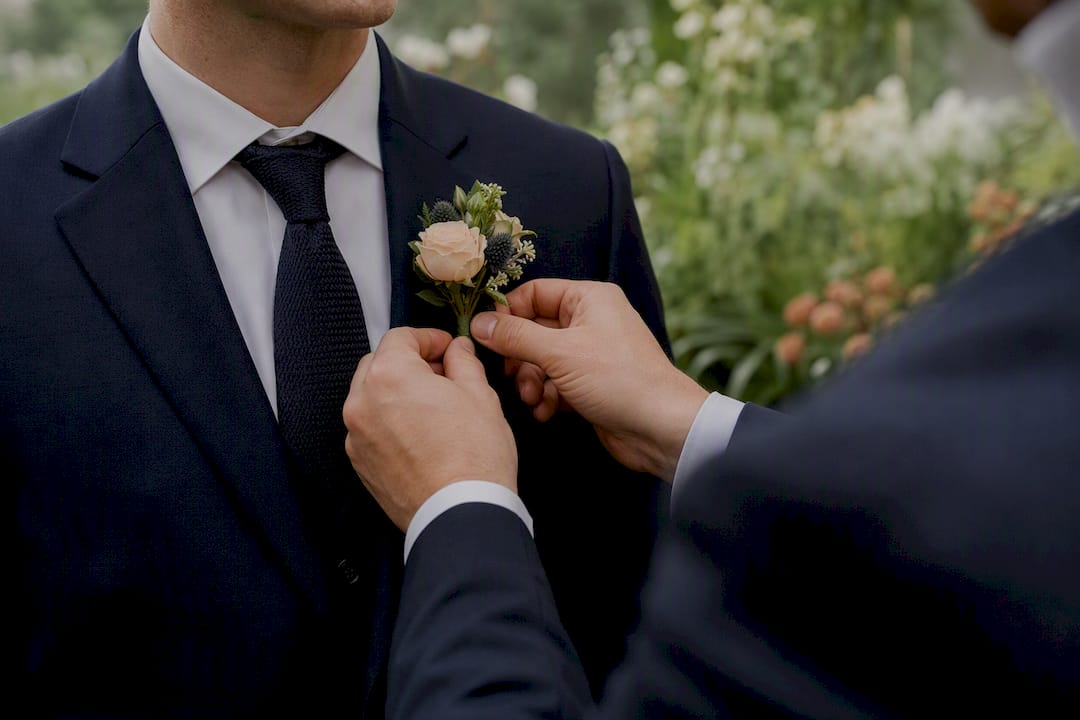
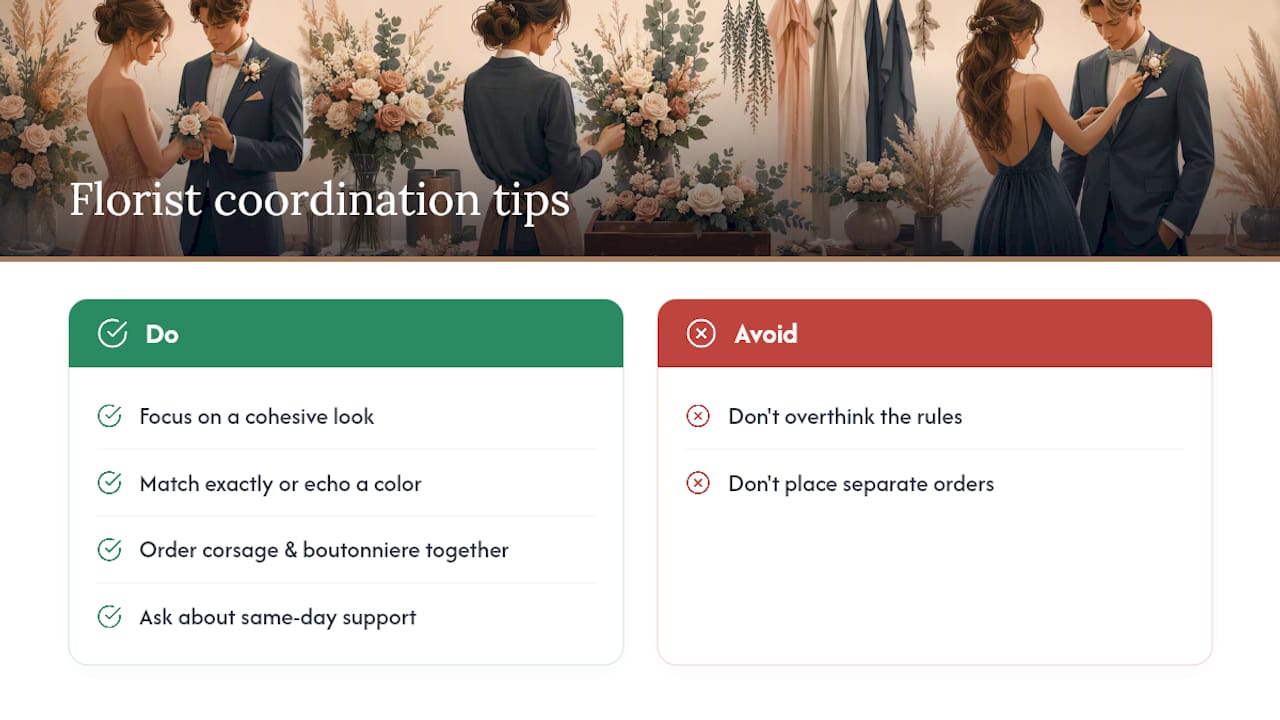
People overthink the “rules” here more than they need to. What actually matters is that everyone standing near the altar or on the dance floor looks like they belong to the same story, whether that means matching exactly or just echoing a color. Lafleurel builds sets around that idea, matching corsages and boutonnieres through one conversation instead of two separate orders, with same-day support when plans change.
Let Lafleurel Handle Your Corsage and Boutonniere Set
Ordering matched florals from two different sources is how mismatched colors happen on your wedding day. Lafleurel handles corsages and boutonnieres as one coordinated order, built from locally sourced blooms with same-day delivery available across Valley Village and the surrounding Los Angeles area.

Bring your color palette, headcount, and attachment preferences (wrist, pin-on, or magnetic) to a quick consultation, and Lafleurel will build a set that matches your larger arrangements, including pieces like the pink and white roses many couples choose as a centerpiece anchor. If you’re also coordinating hair and makeup for the wedding party, luxury bridesmaid packages pair well with a same-day floral timeline. When you’re ready to lock in colors and counts, start your order with Lafleurel and confirm delivery or pickup timing before your event week gets busy.
Frequently Asked Questions
What is the main difference between a corsage and a boutonniere? A corsage is worn by women on the wrist or pinned to a dress; a boutonniere is worn by men in the jacket lapel, usually as a single bloom.
Who traditionally buys the corsage for prom? Custom used to have the male date buy the corsage, but modern etiquette lets couples split the cost or order both pieces as a matched set from one florist.
Can a boutonniere be worn without a jacket buttonhole? Yes. Florists commonly use a magnetic back or a discreet pin through a lined section of fabric when a jacket lacks a functional buttonhole.
Do corsages and boutonnieres need to match exactly? No. Coordinating colors or flower types reads more intentional in photos than forcing an identical match.
How far in advance should I order for a wedding? Two to three weeks ahead works well for larger weddings; smaller prom orders can often be placed just a few days out, with same-day pickup available in many cases.
Sources
- Corsages Versus Boutonnières: What’s the Difference?
- How to Preserve a Corsage
- Boutonniere | Merriam-Webster