

Arrangement sizes generally fall into three tiers: Small or Standard runs about 9 to 12 inches wide, Medium or Deluxe runs 10 to 14 inches, and Large or Premium starts around 14 to 16 inches and up. Price follows stem count and flower type more than footprint, so a compact arrangement of premium blooms can cost more than a bigger one full of greenery. The chart below breaks down exact measurements for each tier.
TL;DR:
- Arrangement size is measured by width at the widest point and height from the vase base to the tallest stem, not just the container size.
- The 1.5 times container height rule helps determine balance and stability, with arrangements over double height requiring additional support.
- The stem count generally follows a 3:5:8 ratio of focal, greenery, and filler stems, scaled up or down depending on arrangement size.
- Larger arrangements around 14 to 16 inches can weigh two to three times more than smaller ones, impacting transportation and handling.
- Funeral arrangements are sized by total linear dimension, with small under 16 inches, medium 16 to 30 inches, and large over 30 inches, differing from tabletop floral tiers.
Table of Contents
- Arrangement Size Chart: Dimensions, Vases, and Where They Fit
- How to Measure an Arrangement (and the 1.5x Vase Rule)
- The 3:5:8 Rule: How Florists Scale Stem Counts by Size
- How to Choose the Right Arrangement Size for Your Space
- Why Bigger Doesn’t Always Mean Pricier
- What Different Arrangement Sizes Actually Look Like Side by Side
- Scaling Arrangements for Weddings, Parties, and Corporate Events
- Transporting and Handling Larger Arrangements
- The La Fleurel Perspective on Sizing Arrangements
- Order the Right Size, Delivered the Same Day
- Where These Sizing Rules Come From
- Sources
Arrangement Size Chart: Dimensions, Vases, and Where They Fit
Florists rarely agree on exact inch cutoffs, but the published ranges from major retailers cluster in the same neighborhood. Here’s how the tiers typically shake out, based on common retail size charts:
| Tier | Width | Height | Common Vase Mouth | Best For |
|---|---|---|---|---|
| Petite / Small | 9–12" | 8–10" | 5" | Desks, nightstands, single-gift gestures |
| Standard / Medium | 10–14" | 10–14" | 6" | Coffee tables, side tables, every day gifting |
| Premium / Large | 14–16" | 14–16" | 7" | Dining tables, entryways, focal centerpieces |
| Statement / Extra-large | 16"+ | 16"+ | 7"+ or urn-style | Weddings, event staging, memorial displays |
Funeral arrangements use a different logic entirely, sized by total linear dimension rather than tabletop footprint: Small runs under 16 inches, Medium spans 16 to 30 inches, and Large exceeds 30 inches. That’s worth knowing if you’re ordering for a service, since the same word “Large” means something very different on a sympathy order than it does on a birthday bouquet.
A few things to keep in mind when matching a tier to a spot in your home:
- A Petite arrangement on a large dining table reads as an afterthought, not a centerpiece.
- A Statement piece on a narrow entry console will look crowded and may tip.
- Vase mouth size matters as much as vase height. A wide-mouthed 6-inch vase holds a fuller Medium arrangement than a narrow 6-inch bud vase ever could.
Retailers also increasingly swap plain size words for descriptive tiers like Standard, Deluxe, and Intricate, which signal design complexity and stem quality rather than just inches. That labeling shift matters more than it sounds. Two arrangements can measure the same 12 inches wide and still differ wildly in price, because one uses filler greens and the other uses garden roses.
How to Measure an Arrangement (and the 1.5x Vase Rule)
Measure width at the widest point, bloom tip to bloom tip, not at the vase. Measure height from the base of the container to the tallest bloom or stem, including any dramatic branches.
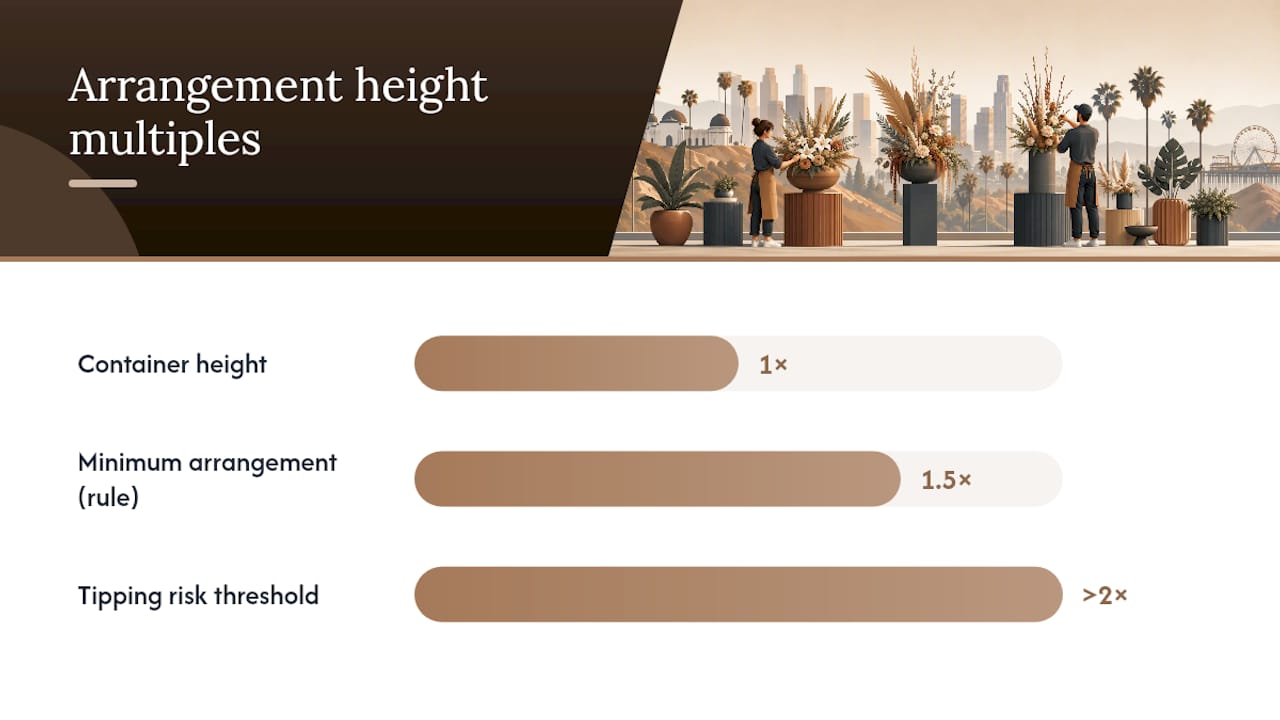
The proportion rule that professional florists use is simple: an arrangement’s height should be at least 1.5 times the height of its container to avoid looking top-heavy or unbalanced. A 6-inch vase, for example, should hold an arrangement that reaches roughly 9 inches tall at minimum. Taller than that is fine, even encouraged, if you want visual drama. Shorter than that, and the flowers tend to look swallowed by the container.
That 1.5x ratio isn’t just about aesthetics. It also flags tipping risk before it happens.
- Anything more than double the container height needs a heavier base or a weighted floral frog to stay upright.
- Top-heavy designs benefit from chicken wire grids inside the vase rather than more stems piled on top.
- Wide, shallow arrangements are more stable in transit than tall, narrow ones.
Pro Tip: If you’re building height for drama, add weight low in the vase first. A heavier container solves more balance problems than extra stems ever will.
The 3:5:8 Rule: How Florists Scale Stem Counts by Size
Most professional arrangements follow a ratio florists call the 3:5:8 rule: three focal blooms, five greenery stems, and eight filler stems. The numbers themselves come from the Fibonacci sequence, which shows up constantly in nature and tends to look “right” to the eye without the viewer knowing why.
Scaling it up or down works like this:
- Small arrangements use the base ratio as written: 3 focal, 5 greenery, 8 filler. That’s roughly 16 stems total, enough for a 9 to 12 inch footprint.
- Medium arrangements keep the focal count at 3 but increase greenery by about 50% and filler by roughly 100%, landing near 3 focal, 7 to 8 greenery, and 15 to 16 filler stems.
- Large arrangements may add a second set of focal blooms (6 total) while scaling greenery and filler proportionally, often reaching 30 or more stems.
Florists themselves note the 3:5:8 rule is a starting guideline, not gospel. Flower size varies so much between species that a design using three dinner-plate dahlias needs a very different stem count than one using three delicate ranunculus.
How to Choose the Right Arrangement Size for Your Space
Start with the surface, not the sentiment. An end table calls for something in the Petite to Standard range, roughly 9 to 12 inches wide, so it doesn’t crowd lamps or photo frames. A coffee table handles a Medium arrangement comfortably. A dining table, especially one set for a meal, needs either a low Standard piece under 14 inches tall or a tall Statement piece elevated well above eye line, since anything in between blocks sight lines across the table.
Then think about intent separately from surface. A small, quiet gesture, like flowers for someone recovering from a rough week, calls for Petite or Standard. A focal display for an event or a milestone celebration calls for Premium or Statement. An arrangement meant to be present but not the center of attention, like office reception flowers, usually sits best at Medium.
When you’re placing an order, three quick questions to the florist will save confusion:
- “What are the width and height in inches, not just the size name?”
- “How many stems, and what’s the mix of focal versus filler?”
- “Will this fit a [container this tall]?” (give the actual vase height you have at home)
Pro Tip: Send a photo of the exact spot you’re placing the arrangement, including anything nearby for scale. Florists size far more accurately from a photo than from a verbal description.
Why Bigger Doesn’t Always Mean Pricier
Size and price track together only loosely. What actually drives cost is stem count, flower variety, seasonality, and design labor, not the measured width of the finished piece.
A compact 10-inch arrangement built from garden roses, ranunculus, and peonies can easily outprice a sprawling 16-inch arrangement made mostly of eucalyptus and baby’s breath. Rare or out-of-season blooms cost more per stem, and dense, tightly packed designs take longer to build than loose, airy ones, which adds labor cost regardless of final size.
A few practical notes on this:
- Ask about stem count or named flower varieties, not just the size label, if budget matters to you.
- “Deluxe” or “Premium” tiers usually signal higher-value focal flowers or extra design time, even when the footprint barely changes from the “Standard” version.
- If you want a luxury look on a smaller budget, ask for a compact arrangement built around one or two premium stems surrounded by affordable greenery, rather than a large arrangement stretched thin.
What Different Arrangement Sizes Actually Look Like Side by Side
Numbers on a chart only go so far. Picture three arrangements sitting in a row: a Petite piece about 10 inches wide looks proportionate on a nightstand, with maybe a dozen stems visible and plenty of negative space between blooms. A Medium arrangement at 12 to 14 inches fills a coffee table without dominating it, dense enough that you notice the greenery texture but still see the vase rim.
A Premium arrangement at 16 inches and up reads completely differently. It has visual weight from across a room. Stems overlap more, focal blooms cluster in twos and threes instead of standing alone, and the greenery often cascades slightly over the vase edge rather than sitting neatly inside it.
The clearest way to picture the jump between tiers is stem density, not just width. A Small arrangement often has visible gaps between blooms, letting greenery show through. A Large arrangement packs stems tightly enough that the container almost disappears under the flowers. That density shift is also why a Large arrangement can weigh two or three times as much as a Small one, which matters when you’re deciding where to place it or how to carry it.
If you’re ordering online, look for product photos that include a hand, a table edge, or a doorway in the frame. Flowers photographed against a blank white background are nearly impossible to judge for true scale, and that’s the single biggest reason people end up surprised when a delivery arrives.
Scaling Arrangements for Weddings, Parties, and Corporate Events
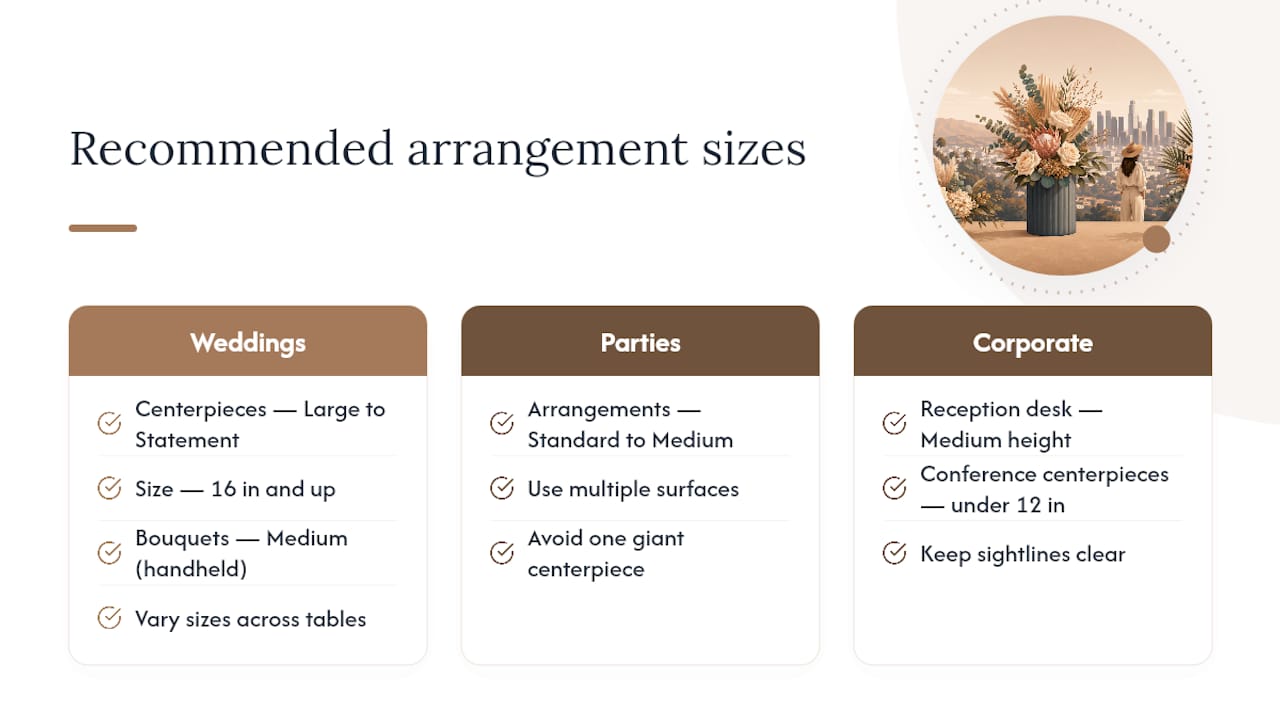
Event florals scale differently than gift arrangements because they need to survive a room, not just a tabletop. Wedding centerpieces typically run Large to Statement, 16 inches and up, because they’re viewed from a distance across a reception table and need to hold visual weight against place settings, glassware, and lighting. Bridal bouquets, by contrast, often stay in the Medium range so they don’t overwhelm the person carrying them in photos.
Parties call for more flexibility. A birthday or anniversary gathering usually does well with Standard to Medium arrangements scattered across multiple surfaces, rather than one giant Statement piece. Spreading the flowers out creates more visual presence throughout a room than concentrating a large budget into a single centerpiece.
Corporate settings have their own logic entirely. A reception desk arrangement should be Medium, tall enough to be noticed but not so wide it blocks sightlines to the person behind it. Conference room centerpieces work best kept low, under 12 inches tall, since they sit at eye level during meetings and a tall piece becomes an obstruction rather than a decoration.
Across all three event types, the mistake to avoid is picking one size and repeating it everywhere. A wedding with identical 16 inch arrangements on every table looks flat compared to one that varies focal-point pieces near the head table against slightly smaller versions elsewhere.
Transporting and Handling Larger Arrangements
Size changes how an arrangement travels, not just how it looks once it arrives. Small and Standard arrangements, generally under 12 inches, transport easily in a car footwell or seat, and their lower center of gravity means minor jostling rarely causes damage.
Large and Statement arrangements are a different story. Anything over 16 inches tall with a narrow vase base is genuinely at risk of tipping during transport, which is exactly why the stabilizing techniques matter, weighted frogs, chicken wire grids, or heavier ceramic containers instead of glass. If you’re transporting a tall arrangement yourself, keep it on a flat floor space rather than a seat, and brake gradually rather than suddenly.
Temperature matters more with larger arrangements too, simply because they contain more stems and more exposed bloom surface area. A Large arrangement left in a hot car for even twenty minutes wilts faster than a Small one, purely due to the volume of open flowers losing moisture at once.
This is one of the practical reasons same-day, professional delivery matters for anything above the Medium tier. A florist’s delivery vehicle is set up to keep arrangements upright and out of direct heat, which a passenger seat generally is not.
The La Fleurel Perspective on Sizing Arrangements
Most sizing confusion comes from treating “Small,” “Medium,” and “Large” as if they mean the same thing everywhere. They don’t. A funeral arrangement’s “Large” and a birthday bouquet’s “Large” describe entirely different objects, and most retail charts blur that distinction rather than clarifying it.
Some florists build arrangements around locally sourced, naturally grown blooms with descriptive tiers rather than vague size labels alone, sometimes offering same-day delivery in local areas. When a standard tier doesn’t fit the table, the vase, or the occasion, a custom consultation is the better route than forcing a stock size to work.
— Ovannes
Order the Right Size, Delivered the Same Day
Once you know your tier, ordering gets simple. For a Petite or Standard gift, A Beautiful Day Arrangement sits comfortably in the 10 to 12 inch range, ideal for a desk or nightstand. If you’re aiming for Medium with premium stems, the Peonies Bouquet delivers that fuller look without tipping into Statement territory. For a dining table or event centerpiece that needs to hold its own across a room, Pure Elegance is built at the Large tier from the ground up.
Every order ships with same-day delivery within Valley Village and the surrounding Los Angeles area, and if none of the standard tiers match your table, vase, or occasion exactly, a custom arrangement consultation lets you specify the footprint, stem mix, and container size directly. Browse the full Lafleurel catalog to compare tiers side by side, or reach out with your vase height and table dimensions and get a size recommendation before you order.
Where These Sizing Rules Come From
- The 3:5:8 stem ratio comes from floral design education, not a marketing invention.
- The 1.5x container height rule is standard guidance taught in floral art schools.
- Funeral-specific size thresholds are drawn from retail funeral flower charts.
Sources
- What is the 3:5:8 rule in floristry? — Florist Toolbox
- Basic rules of flower arranging — Floral Art School
- Size Chart - Floral Arrangements — Spruce
- What wedding flowers really cost — BleVior Design
- Funeral arrangement sizes explained — FloristOne