

Sunflowers and yellow tulips or roses are the safest, most meaningful choice for almost any graduate. Lilies and orchids read as more refined, which makes them a better fit for a master’s, PhD, or professional-school recipient. The rule that actually matters: match the bouquet’s tone to the graduate’s level and your relationship to them, then check that the blooms can survive heat, travel, and a few hours of photos before you order.
TL;DR:
- Sunflowers and yellow tulips are durable, universally suitable graduation flowers that photograph well and symbolize loyalty and celebration.
- Potted orchids and white lilies are ideal for advanced degrees, offering long-lasting elegance and requiring care to prevent pollen stains on gowns.
- Flower choices should align with the graduate’s level and relationship, with simpler, cheerful arrangements for high school and more refined options for higher degrees.
- Practical considerations include preordering at least three to five days in advance, removing lily stamens, and transporting flowers in shade to maintain freshness.
- Budget ranges from $25 for basic high school bouquets to over $100 for premium arrangements featuring peonies or orchids, based on complexity and seasonality.
Table of Contents
- Best Graduation Flowers and What They Mean
- How to Choose by Graduation Level and Relationship
- Color Symbolism and How to Pair It Right
- Bouquet Styles That Actually Hold Up on Graduation Day
- When to Order and How to Keep Flowers Fresh After the Ceremony
- Quick DIY: Build a Graduation Bouquet in About 30 Minutes
- Why This Guide Reflects Real Florist Practice
- What Actually Matters When You’re Choosing Graduation Flowers
- Ready-to-Order Graduation Bouquets from Lafleurel
- Sources
Best Graduation Flowers and What They Mean
Every flower on a graduation table is doing double duty. It has to look good in photos taken outdoors, in direct sun, often at 2 p.m. in May, and it has to say something true about the person receiving it. Here’s what the strongest options actually communicate, along with the practical trade-offs a florist would tell you about.
- Sunflowers: Adoration and a bright future, plus real durability. Their size and heliotropism (the way they track the sun) make them read as loyal and forward-looking, and they hold up in heat better than almost anything else on this list, which is why sunflower and yellow tulip combinations are recommended as universal, photo-ready picks.
- Yellow tulips: Cheerful, unambiguous congratulations. There’s no romantic undertone to worry about, so they work for a coworker, a niece, or a professor you barely know.
- Yellow, pink, or white roses: Friendship, admiration, and new beginnings, respectively. Skip red unless the graduate is your partner. Red roses carry a romantic weight that gets confusing fast in a graduation context.
- Lilies: Dignity and new beginnings, especially white lilies for advanced degrees. Ask the florist to remove the stamens before delivery. Lily pollen stains fabric permanently, and nobody wants an orange smear on a graduation gown or a nice shirt.
- Orchids: Elegant and long-lasting, which makes them a strong pick for doctoral or professional-degree recipients. A potted orchid works especially well here since it outlives the ceremony by months instead of days.
- Peonies: Prosperity and abundance, and one of the more premium seasonal choices. They’re gorgeous but genuinely limited. Peonies bloom in a narrow window from late April to early June, which happens to overlap with graduation season, though supply gets tight and prices climb accordingly.
- Gerbera daisies, carnations, daffodils, chrysanthemums: Reliable, budget-friendly alternatives. Gerberas photograph almost as well as sunflowers, carnations stretch a bouquet’s fullness without stretching the price, and daffodils and chrysanthemums add texture without competing for attention.
How to Choose by Graduation Level and Relationship
The flower list only works once you filter it through who you’re buying for and what stage they’ve reached. Think of it as a dial that moves from playful to elegant as the degree gets more advanced.
- High school: Go bright and easy to carry. Sunflowers, gerbera daisies, and yellow tulips fit the celebratory, slightly chaotic energy of a high school graduation. A small fun add on, like a mini balloon tucked into the wrap or a school-color ribbon, fits the tone without looking out of place.
- Bachelor’s or college: Aim for refined but still celebratory. Peonies, mixed roses, and tulips work well here, and a composed, hand-tied bouquet reads more grown-up than a loose, oversized one. This is the level where a peonies bouquet or a polished rose arrangement genuinely earns its price.
- Master’s, PhD, or professional degree: Understated elegance wins. White lilies, orchids, and purple irises signal wisdom and accomplishment without shouting. A potted orchid or a long-lasting arrangement is worth considering here, since these recipients often value something that lasts weeks over something that peaks in three days.
- Relationship matters as much as level: For a friend or colleague, stick with yellow or pink. For a parent, peonies or a rose-forward arrangement lands well. For a partner, romantic accents like red roses are finally fair game.
Color Symbolism and How to Pair It Right
Color carries more weight than most people realize when picking graduation flowers. Yellow signals achievement and friendship, white signals new beginnings, pink reads as admiration, purple suggests wisdom, orange brings energy, and red is the one to reserve for romantic relationships since it carries a different message entirely.
Pro Tip: If you’re not sure what a color says about your relationship to the graduate, default to yellow. It’s the one hue that never reads as anything but congratulations.
A few pairings do the heavy lifting without overthinking it:
- Sunflowers plus yellow tulips: the classic, foolproof combination for any general graduation gift.
- White lilies plus lavender roses: a quieter, more sophisticated pairing suited to advanced degrees.
- Gerbera daisies in mixed brights: an affordable way to add color without a single dominant flower stealing the shot.
School colors are worth a nod but not a rulebook. If a school’s colors are maroon and gold, lean into gold-toned blooms rather than trying to force maroon flowers, which are rare and often muddy in photos next to a graduation gown.
Bouquet Styles That Actually Hold Up on Graduation Day
The format matters almost as much as the flowers themselves. A handheld bouquet photographs beautifully and travels well in a car, but it wilts faster than a potted arrangement. A potted plant, like a small orchid, lasts for weeks and works better as a lasting gift than a photo prop. Posies split the difference: compact, easy to hold one-handed during a hug, and sturdy enough for a full ceremony day.
Leis and garlands carry strong regional traditions, especially in Hawaii and parts of the West Coast, and they can be personalized with ribbon colors or small charms tied into the strand. Cap decor has become its own small art form. Waterproof floral clips let you attach a bloom or two to a mortarboard without damaging the cap or wilting before the ceremony ends. Corsages and boutonnieres should stay small and proportional. A single rose or a cluster of baby’s breath reads better on a lapel than an oversized cluster that looks like it belongs in a bouquet instead.
For photos, contrast is everything. Bright blooms against a dark gown pop; pale blooms against a light gown can wash out entirely. Choose a photo-ready arrangement sized to be visible from typical photo distance, not just up close, and avoid heavy-pollen flowers near the face unless the stamens have been removed.
- Handheld bouquets: best photo impact, shortest lifespan.
- Potted plants: longest lifespan, less dramatic in photos.
- Leis and cap decor: personal and photogenic, but plan ahead for placement.
- Corsages and boutonnieres: keep them proportionally small.
When to Order and How to Keep Flowers Fresh After the Ceremony
Preorder whenever you can. Graduation season clusters heavily in May and June, and that peak demand stretches lead times at local florists, so same-day ordering should really be a backup plan, not the default. Here’s a simple sequence to follow:
- Order at least three to five days ahead during peak season, and mention any color or ribbon preferences up front.
- Ask the florist to remove lily stamens if your bouquet includes them, and request sturdier, large-headed blooms like sunflowers or gerberas if the ceremony is outdoors in heat.
- Transport flowers in a cooler, shaded container rather than a hot trunk, especially if there’s more than a 20 minute drive involved.
- After the ceremony, trim an inch off each stem at an angle, place them in lukewarm water, and keep the arrangement out of direct sun.
Budget expectations vary by ambition. Most local florist bouquets run between $35 and $85, with simple high school arrangements starting around $25 and premium doctoral-level bouquets, often built around orchids or peonies, climbing toward $100 to $120.
Quick DIY: Build a Graduation Bouquet in About 30 Minutes
You don’t need floral training to put together something that looks intentional. Gather 8 to 12 stems (mix a focal flower like sunflowers or roses with a filler like baby’s breath), floral tape, shears, kraft paper, and ribbon.
- Strip the lower leaves off every stem so nothing sits in the water line.
- Cut each stem at a 45 degree angle, which improves water uptake and keeps blooms fresher longer.
- Start with your focal flower in hand, then add stems one at a time, rotating slightly each time to build a spiral base.
- Layer in filler flowers between the focal stems to fill gaps.
- Secure the bunch with floral tape where your hand naturally grips.
- Wrap the stems in kraft paper and finish with a ribbon in the graduate’s school colors, or tie on a mini tassel for a personal touch.
The whole process takes about half an hour and costs a fraction of a made-to-order arrangement.
Why This Guide Reflects Real Florist Practice
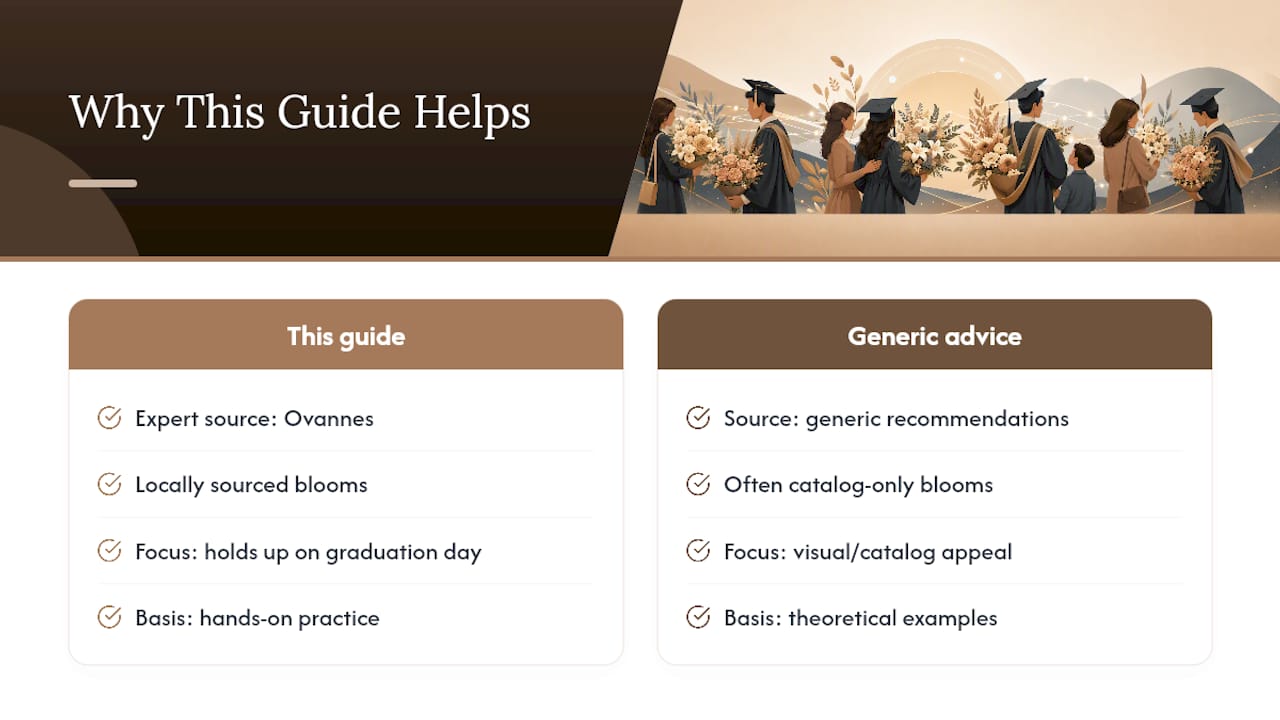
This guide draws on hands-on floral expertise from Ovannes, who has spent years matching bloom choices to real occasions rather than generic advice. This guide backs that experience with floral arrangements built from locally sourced blooms, so recommendations here reflect what actually holds up on a graduation day, not just what looks good in a catalog.
What Actually Matters When You’re Choosing Graduation Flowers
Most graduation flower advice treats every degree the same, and that’s the biggest miss in this whole category. A high schooler and a PhD candidate are not looking for the same emotional register, and sending an oversized, roses-and-baby’s-breath bouquet to a 22-year-old with a chemistry doctorate can land oddly formal in the wrong way, or oddly juvenile in the other direction.
The color-and-symbolism angle gets overplayed too. Nobody’s grandmother is going to decode “purple means wisdom” at a graduation party. What actually lands is whether the flowers look intentional, survive the afternoon, and photograph well against whatever the graduate is wearing. That’s a logistics problem as much as a symbolism problem, and it’s the part most guides skip.
If you take one thing from this: prioritize durability and scale over cleverness. A sunflower that’s still standing tall for the 6 p.m. dinner beats a delicate arrangement that wilted by 3 p.m., no matter how perfect its meaning was on paper.
— Ovannes
Ready-to-Order Graduation Bouquets from Lafleurel
Skip the guesswork on stem counts and spiral technique. Handcrafted graduation arrangements built from locally sourced blooms are available with same-day delivery in the local area, so you can order the morning of and still have something ceremony-ready by afternoon.

For a general congratulations gift that photographs well against nearly any gown color, the Beautiful Day arrangement hits the bright, celebratory tone that works for high school through college. If you’re buying for a bachelor’s or master’s graduate and want something closer to refined than playful, the Quicksand Beige Roses Arrangement leans elegant without tipping into overly formal. Parents shopping for a college graduate often gravitate toward the Romantic Garden arrangement with Peonies, which captures the prosperity symbolism peonies are known for.
When you order, mention if you want ribbon colors matched to the graduate’s school, and ask about stamen removal if your arrangement includes lilies. Browse the full same-day delivery catalog to check availability for your ceremony date.
Sources
- Graduation Flowers: Blooms That Mean Achievement and Success (With Colour Guide by Field) - Blooming Expert
- Graduation Bouquet Ideas: Best Flowers & Colors to Gift - MyGlobalFlowers
- 10 Best Flowers For Graduation - UrbanStems