

Reception areas do best with a weekly subscription built around one statement arrangement; desks and meeting tables need small, low-maintenance bouquets or resilient potted plants instead. If you manage a busy lobby or client-facing floor, request a sample delivery or a short consultation before committing to a cadence. Lafleurel handles both formats, from single orders to recurring corporate accounts.
TL;DR:
- Choosing the right format depends on the space, with reception areas suited for large arrangements and desks for small, low-maintenance plants.
- Orchids and anthuriums excel in office durability, lasting weeks with minimal upkeep, while tulips are better for weekly refreshes due to shorter lifespan.
- Vendor relationships benefit from clear scheduling, ownership of vases, and documented policies on maintenance, refunds, and cancellations.
- Costs can vary widely, from $25 to $60 for desk bouquets to several hundred dollars for large lobby installations, with billing often on a monthly flat rate.
- Starting with a statement arrangement in a high-visibility space is recommended to test the vendor’s reliability before expanding to other areas.
Table of Contents
- Subscription, One-Off, and Plant Formats for Offices
- Which Flowers and Plants Actually Hold Up in an Office?
- Where Should You Actually Place an Office Arrangement?
- What Do Office Flower Arrangements Cost?
- How Do You Vet a Flower Vendor Before Signing?
- How Lafleurel Fits Into Your Office Floral Plan
- Delivery Logistics, Vases, and Larger Installs
- One-Off Orders vs. Subscriptions: Which Fits Your Office?
- How Much Can You Customize an Office Arrangement?
- What Actually Drives Up Your Total Cost?
- What I’d Tell an Office Manager Setting This Up for the First Time
- Ready to Order Office Flowers? Here’s Where to Start
- Sources
Subscription, One-Off, and Plant Formats for Offices
Most office flower delivery falls into three buckets: subscriptions, one-time orders, and potted plants. Subscription plans typically run weekly, biweekly, or monthly, and vendors commonly include the vase, a scheduled swap, and pickup of the spent arrangement as part of the service. Corporate subscriptions often price by coverage area, meaning a single desk costs less than reception, and reception costs less than a whole-floor package.
Matching the format to the space matters more than picking the “best” flower. A lobby or reception desk can carry a large, structural piece because there’s room and sightlines to support it. Meeting tables need something low enough that people can see each other across it. Desks do better with compact posies or a plant that needs no daily attention.
- Reception/lobby: one statement arrangement, weekly or biweekly refresh
- Meeting tables: low-profile centerpieces, swapped biweekly
- Desks: small bouquets or a single resilient plant
- Open floor areas: taller floor plants for visual anchoring
Cut flowers deliver more immediate visual impact and work well for client-facing zones, but they need water changes and eventual replacement. Live plants cost less to maintain over time and suit low-traffic corners, though they lack the seasonal color a fresh bouquet brings.
Which Flowers and Plants Actually Hold Up in an Office?
Not every bloom survives a week under fluorescent lighting and recycled air. Orchids are the standout choice for reception desks because they can last several weeks with minimal upkeep and almost no scent, which matters in shared air. Anthuriums bring a similar durability with a waxy, sculptural look that reads as intentional rather than decorative filler. Tulips are lower cost and low-scent but shorter-lived, so they suit weekly-refresh accounts better than monthly ones.
Foliage does more work than most office managers give it credit for. Eucalyptus and ruscus hold their shape and color long after flowers fade, so a designer can rebuild an arrangement around the same greenery for two or three refresh cycles.

Pro Tip: Ask your florist to bill foliage separately from blooms on a subscription. Greenery lasts longer, so you’re often paying to replace flowers only, not the whole structure.
For desks and darker corners, skip cut flowers entirely. Low-light tolerant plants such as the snake plant, ZZ plant, and pothos survive offices with no natural window access and need watering only every week or two.
- Orchids: long vase life, virtually scentless
- Anthuriums: sculptural, durable, low scent
- Tulips: affordable, best for weekly cadence
- Snake plant, ZZ plant, pothos: near-zero maintenance for low light
A florist’s rule of thumb worth borrowing: the 3:5:8 ratio, using three focal blooms, five secondary flowers, and eight foliage stems, tends to produce a balanced arrangement without looking overstuffed or sparse.
Where Should You Actually Place an Office Arrangement?
Placement decides whether an arrangement gets noticed or gets knocked over by the third day.
- Put the largest piece where people wait or gather, reception desks, elevator lobbies, not in a back hallway nobody walks through.
- Keep meeting-table pieces low enough so people can see each other while talking.
- Avoid direct sun exposure and HVAC vents, both accelerate wilting and dry out stems faster than normal.
- Skip heavy-scent varieties like lilies near conference rooms or shared desks where allergy sensitivity is a real concern.
- Recut stems and refresh the water every two to three days. Simple conditioning steps like this measurably extend vase life.
Pro Tip: If you’re managing this internally rather than through a vendor’s refresh visit, put stem-trimming and water changes on someone’s actual calendar. “Someone will handle it” is how arrangements die by Thursday.
If you’re writing a vendor scope of work, spell out who owns the maintenance visits, how often, and what happens if a piece wilts early. Vague language here is where most service complaints start.
What Do Office Flower Arrangements Cost?
Pricing swings widely based on scale and frequency, but rough ranges hold across most markets. Desk bouquets tend to run $25 to $60 per piece, reception subscriptions often fall between $75 and $200 per delivery depending on size and flower selection, and full event or lobby installs can run several hundred dollars per visit once labor and larger floral volume are factored in.
Billing usually works one of two ways. Per-delivery invoicing charges you each time a driver shows up, which suits offices ordering occasionally or testing a vendor. Monthly flat invoicing consolidates several visits into one predictable charge, and as accounts scale from a single reception piece to whole-floor coverage, vendors typically shift toward this model because it also folds in logistics coordination and priority scheduling.
Before signing anything, confirm in writing:
- Number of deliveries included per billing cycle
- Whether vase cleaning and swap-out is part of the fee or billed separately
- The replacement policy if an arrangement arrives damaged or wilts early
- Any surcharges for rush orders, holidays, or building access fees
Quotes that skip these details tend to surprise you later with add-on charges.
How Do You Vet a Flower Vendor Before Signing?
A good vendor conversation should answer five things fast: can they show sample work, what’s their actual delivery cadence, who do you call if something’s wrong, who handles ongoing maintenance, and what happens to the vases between deliveries.
- Ask for photos of arrangements they’ve delivered to similar office spaces, not just wedding or event work.
- Confirm the delivery window lands before morning meetings, not mid-afternoon when the lobby’s already full of visitors.
- Request a Certificate of Insurance if the vendor will be inside the building doing installs, most property managers require one for third-party vendors on-site.
- Ask whether pauses (holidays, office closures) are handled with a written policy or informal texts that get lost.
Red flags worth walking away from: no written pause or cancellation policy, pricing that changes after the first invoice, and no local references you can actually call.
How Lafleurel Fits Into Your Office Floral Plan
Lafleurel builds every arrangement by hand using locally sourced, naturally grown blooms, and offers same-day delivery across Valley Village and the surrounding Los Angeles area, which matters when a client meeting gets moved up with two hours’ notice. For corporate accounts, that same-day capability turns into a real advantage: last-minute lobby refreshes and unplanned event decor don’t require a week’s lead time.
Lafleurel fits best when you want a weekly refresh schedule paired with designs built specifically for client-facing spaces, not a generic bundle assembled off a shelf. Getting started is simple: request a consultation, order a sample delivery to see the quality firsthand, or set up ongoing account management for recurring reception and desk coverage.
Delivery Logistics, Vases, and Larger Installs
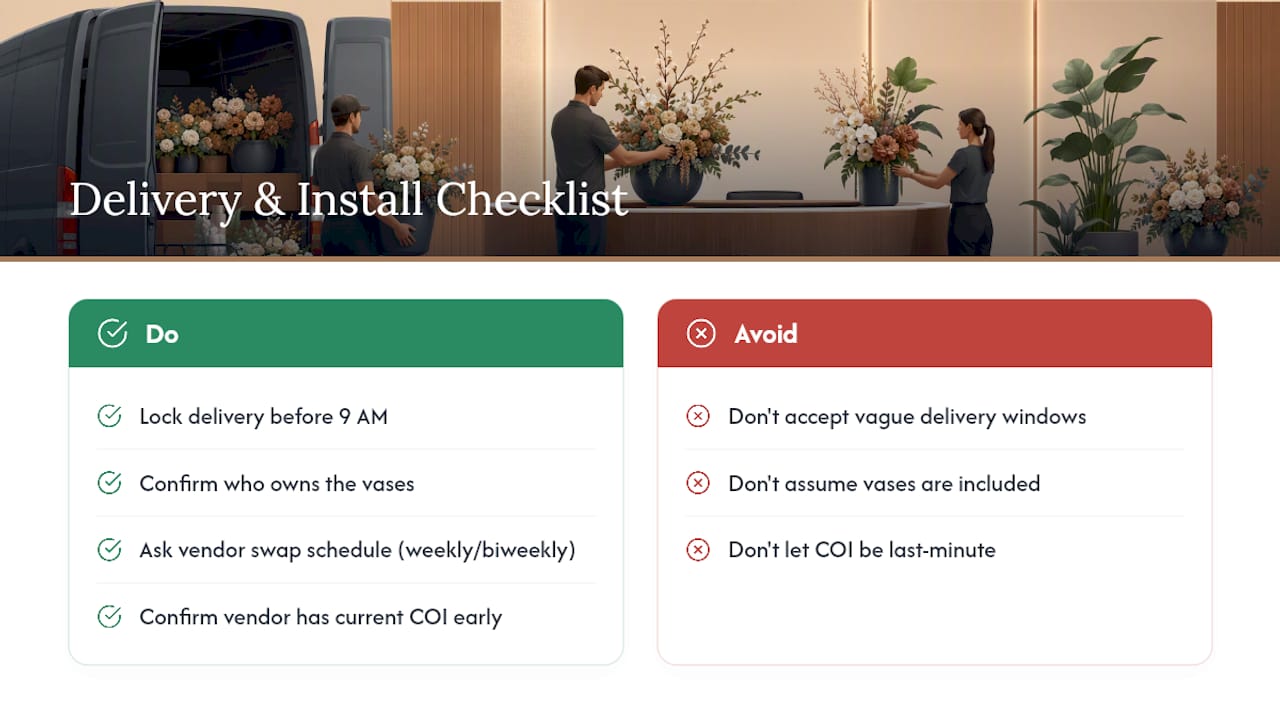
Once you’ve picked a format, the operational details determine whether the relationship actually runs smoothly. Delivery scheduling should be locked to a specific window, ideally before 9 AM so pieces are staged before the first meeting or visitor arrives. Ask whether the vendor owns the vase or if you’re expected to supply and maintain your own; most subscription services provide and rotate vessels as part of the fee, swapping a clean one in when they deliver the new arrangement.
Exchanges and refresh visits work differently depending on the contract. Some vendors swap the entire piece on a fixed schedule, weekly or biweekly, regardless of condition. Others run a hybrid model where they check condition first and only replace what’s actually declining, which can stretch your budget further if your office has good indirect light and stable temperatures.
For larger installs, think lobby atriums, multi-floor placements, or event decor tied to a company gathering, building management will often require documentation before allowing a vendor on-site. A Certificate of Insurance protects the property owner if something is damaged during setup, and most commercial buildings won’t let a florist past the loading dock without one on file. Confirm this requirement early; it’s a common reason installs get delayed at the last minute. Ask your vendor whether COI paperwork is something they keep current and can send quickly, since a vendor who has to scramble for one signals disorganization elsewhere in their operation.
One-Off Orders vs. Subscriptions: Which Fits Your Office?
The right answer depends less on budget and more on how predictable your floral needs actually are. If your office hosts client visits sporadically, quarterly board meetings, occasional interviews, a one-off order makes more sense than paying for weekly service you don’t consistently need. You order a statement arrangement ahead of the event and skip the commitment entirely.
Subscriptions earn their cost when the space is client-facing every single day. A law firm’s reception desk, a real estate office’s front lobby, a medical practice’s waiting room, these get seen constantly, and a wilting arrangement left too long actively hurts the impression you’re trying to make. Weekly or biweekly refresh keeps that space consistently presentable without anyone internally having to think about it.
There’s a middle path worth considering too: start with a one-off order for a month or two, gauge how staff and visitors respond, then convert to a subscription once you’ve confirmed the cadence and format that actually works for your space. This avoids locking into a monthly contract before you know whether reception needs weekly service or biweekly is plenty.
Offices with mixed needs, a formal reception plus casual break room, sometimes split the difference: subscription coverage for the client-facing space, occasional one-off orders for internal celebrations or desk gifts. That flexibility tends to work better than forcing every space into the same billing model.
How Much Can You Customize an Office Arrangement?
Flower type, color palette, and seasonal theme are all adjustable, and a good vendor should ask about your brand colors before ever proposing a design. Offices with a strong visual identity, law firms in navy and gold, tech companies in cleaner whites and greens, often request arrangements that echo those tones rather than defaulting to generic reds and pinks.
Muted, sustainable palettes using locally sourced blooms have become a common direction for corporate spaces wanting an understated look rather than anything too loud for a professional setting. A beige and neutral rose arrangement fits that direction well, reading as polished without competing with the room’s decor.
Seasonal themes are another easy lever. Warmer citrus tones in fall, whites and greens around the winter holidays, pastels in spring, all give a reception desk a sense of change without requiring a full redesign each time. Just confirm with your vendor how far in advance seasonal swaps need to be requested, since specialty stems for a particular season sometimes need longer lead times than the standard weekly order.
What Actually Drives Up Your Total Cost?
The quoted price per arrangement is rarely the full picture. Delivery fees vary by distance and urgency, and same-day or rush requests typically carry a premium over standard next-day scheduling. If your office sits outside a vendor’s core delivery zone, ask directly whether that adds a surcharge, some vendors fold it into the quote and others tack it on separately.
Setup charges apply mainly to larger installs, lobby pieces requiring assembly on-site, or event decor needing staging time beyond a simple drop-off. A small desk bouquet doesn’t carry this cost; a floor-to-ceiling reception display often does.
Cancellation policies deserve real scrutiny before you sign anything. Ask what happens if you need to pause service for a slow month, skip a single delivery, or cancel the account entirely. Vendors without a written pause policy tend to handle these situations inconsistently, sometimes charging full price for a skipped week, sometimes not, depending on who answers the phone that day. Get the specifics in writing rather than relying on a verbal assurance that “we’ll work something out.”
What I’d Tell an Office Manager Setting This Up for the First Time
Start with reception, not desks. A single well-placed statement piece changes how the whole floor feels, and it’s the easiest win to justify to whoever approves the budget. Desk pieces and plant additions can follow once you’ve confirmed the vendor actually shows up on schedule.
The mistake I see most often is offices trying to standardize every space at once instead of testing cadence with one high-visibility spot first.
— Ovannes
Ready to Order Office Flowers? Here’s Where to Start
If you’ve read this far, you already know the format that fits your space, so the next move is simple: pick a piece and place the order. For reception and lobby areas, Pure Elegance delivers the statement presence a client-facing desk needs. Desks and meeting-room credenzas do better with something smaller like A Beautiful Day, and offices leaning toward a quieter, brand-neutral palette should look at the Quicksand Beige Roses arrangement.
Every arrangement is handcrafted from locally sourced blooms with same-day delivery across Valley Village and the greater Los Angeles area, so a last-minute client visit doesn’t mean scrambling. Corporate and event contracts are available for offices wanting recurring coverage rather than single orders.
Request a sample delivery first if you’re not ready to commit to a weekly cadence, or start a consultation to talk through reception subscription options, desk bundles, and pricing for your specific floor plan. If your building requires layout adjustments to fit a larger reception display, space-planning guidance for open offices can help you figure out where a statement piece actually fits without crowding a shared walkway.
Sources
- Extend vase life of your fresh flowers with a little care — University of Illinois Extension
- Best office plants | The Sill