

Buy local when freshness, fragrance, and vase life matter most, or when you want a lighter carbon footprint and a direct line to the grower. Choose imported stems when you need an out-of-season variety, an exotic bloom your region can’t grow, or the lowest possible price on standard commodity flowers. A local florist splits the difference well: locally-sourced, naturally-grown blooms with timely delivery cover most everyday occasions without the transit lag.
TL;DR:
- Local flowers typically arrive within 24 to 72 hours of harvest, while imported stems may spend up to a week in transit, reducing freshness.
- Buying in season and avoiding artificial climate control can significantly lower the environmental impact of local flowers compared to imported ones.
- In-season local flowers usually cost less than imported blooms, except during holidays when prices spike for both sources.
- Florists often blend local and imported flowers based on design needs, with exotic imports providing variety beyond seasonal local options.
- Always ask for the harvest date and origin details before purchasing to ensure maximum freshness and ethical sourcing.
Table of Contents
- Local vs Imported Flowers at a Glance
- How Fresh Are Local Flowers Compared to Imported Ones?
- What Is the Real Environmental Cost of Imported Flowers?
- Why Do Imported and Local Flowers Cost So Differently?
- Should You Choose Local or Imported for Variety and Design?
- Are There Ethical Concerns With Imported Flowers?
- A Quick Checklist for Choosing Local, Imported, or Both
- How Lafleurel Puts Local Sourcing Into Practice
- Do Local and Imported Flowers Need Different Care After Purchase?
- Author’s Takeaway
- Get Locally Sourced Arrangements With Same-Day Delivery
- Sources
- FAQ
Local vs Imported Flowers at a Glance
The gap between a bouquet cut yesterday and one that flew in from another continent shows up in more than just the price tag.
- Freshness and vase life: Local flowers often reach buyers within 24 to 72 hours of harvest; imported stems can spend days to a week in transit before they reach a shop.
- Carbon footprint: A dozen imported roses can generate roughly 30 pounds of CO2 from air freight and refrigeration; a local, in-season bouquet’s footprint can run closer to a third of that.
- Price patterns: Local stems are often cheaper in season and pricier or unavailable off-season; imported commodity flowers hold steady prices year-round.
- Variety: Imported supply chains deliver exotic, year-round options; local farms deliver seasonal, often more fragrant varieties.
- Ethics: Some import regions carry documented pesticide and labor concerns, while U.S. small farms operate under domestic labor and environmental rules.
At least [80% of cut flowers sold in the U.S. are imported](https://horticulture.umn.edu/news/local-cut-flower-production), frequently from Colombia, Ecuador, or the Netherlands, often traveling thousands of miles before they reach a vase.
How Fresh Are Local Flowers Compared to Imported Ones?
Freshness comes down to a timeline. Local flowers typically move from field to customer in 24 to 72 hours. Imported stems travel for days, sometimes a full week, which means florists lean on cold storage and preservative treatments just to keep them presentable on the shelf.
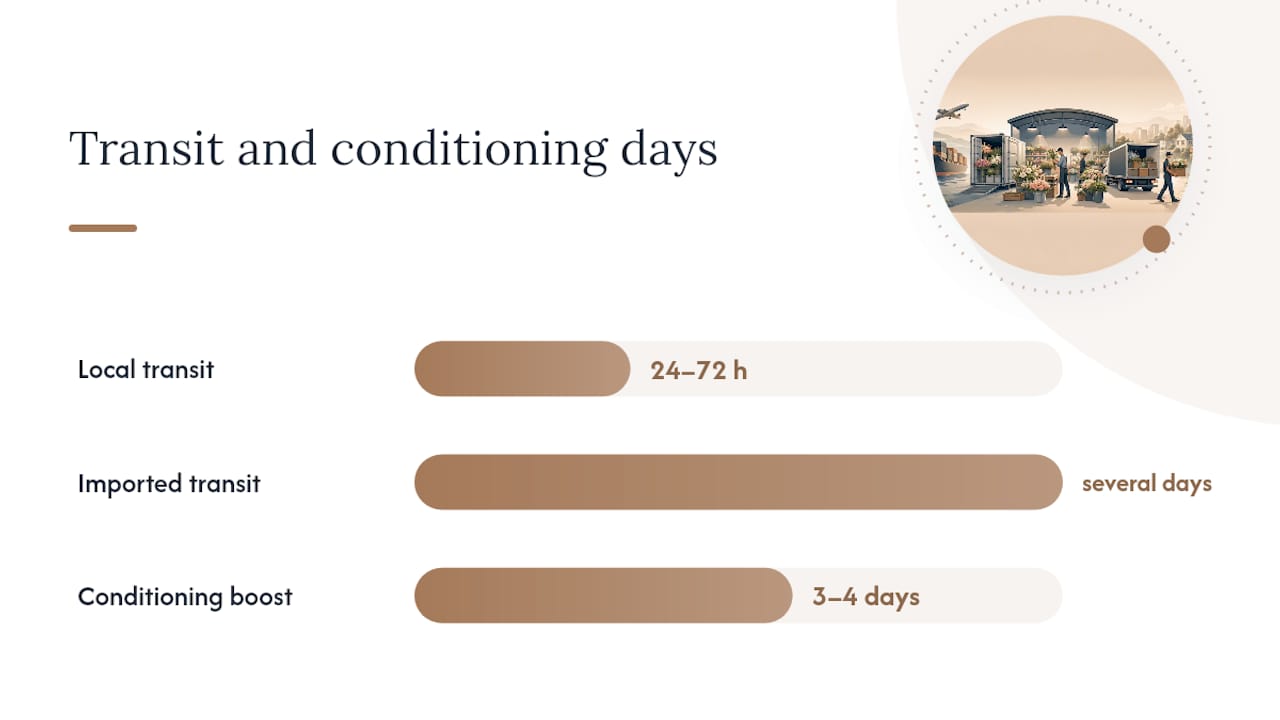
That treatment creates a strange paradox: imported flowers can look flawless while already losing the qualities that matter most up close. Refrigeration and post-harvest chemicals extend visible shelf life, but they mask cellular dehydration that happened days earlier. Varieties bred for export are also often selected for shipping durability over scent, which is part of why a picture-perfect imported rose can smell like almost nothing.
Conditioning helps either type of flower go further:
- Cut an inch off each stem at an angle before placing it in water.
- Use lukewarm water mixed with the packet of flower food that came with your bouquet.
- Remove any leaves that will sit below the waterline.
- Keep arrangements away from direct sun, heat vents, and ripening fruit.
- Change the water every two days and re-cut stems if they start to droop.
Pro Tip: Local flowers respond faster to conditioning because they haven’t spent days dehydrating in transit. Give them a fresh cut and clean water the moment you get home, and you’ll often see an extra three to four days of vase life.
What Is the Real Environmental Cost of Imported Flowers?
Most of an imported bouquet’s environmental cost comes from getting it to you, not growing it. Air freight, refrigerated cold-chain storage, and long-haul trucking make up the bulk of what’s often called flower miles, and the math adds up fast on delicate cargo that has to stay cold the entire way.
A dozen imported roses can generate approximately 30 pounds of CO2, while a locally grown, in-season bouquet’s footprint can run to roughly a third of that. Run that number through the EPA’s greenhouse gas equivalencies calculator and it lands close to the emissions from driving a standard car more than 30 miles, just for a dozen roses.
There’s a real nuance here worth knowing: local isn’t automatically clean. A greenhouse running heat lamps through a Midwest winter burns energy too, so the environmental edge for local flowers is strongest when they’re grown in season, outdoors or in unheated tunnels, not year-round under artificial climate control.
Buyers who want to shrink their footprint without overthinking it can do three things: buy what’s actually in season, ask a florist how their stems were grown, and skip the plastic sleeve for simple paper wrap.
Why Do Imported and Local Flowers Cost So Differently?
Price differences trace back to five drivers: growing scale, transport cost, import tariffs, holiday demand spikes, and climate-driven scarcity. Imported growers benefit from massive scale and consistent year-round climate, which keeps commodity prices low even after air freight. Local growers face smaller batches, seasonal windows, and higher per-stem labor costs, but skip the transport markup entirely.
That trade-off plays out predictably at checkout:
- In-season local flowers, like peonies in spring, often beat imported prices on comparable stems.
- Off-season local blooms get expensive fast or simply disappear from availability.
- Holiday demand (Valentine’s Day, Mother’s Day) pushes both local and imported prices up, but imported roses usually spike harder.
- Ordering two to three weeks ahead of a major holiday locks in better pricing and selection either way.
- Mixed-source arrangements, a local seasonal base with one or two imported accent stems, can control cost without sacrificing the look you want.
Should You Choose Local or Imported for Variety and Design?
Local farms tend to produce whatever is thriving that month: dahlias and zinnias in late summer, peonies and ranunculus in spring, and rich foliage in fall. Imported supply chains exist to erase that seasonality, delivering roses, orchids, and lilies on demand, 365 days a year, regardless of climate.
Good florists blend both sources depending on the design brief:
- A rustic, garden-style arrangement usually calls for local, seasonal varieties with natural imperfection built in.
- A formal event with a specific color palette often needs imported stems for consistency and volume.
- Exotic varieties like certain orchids or proteas typically have no local substitute in most U.S. regions.
- Buyers who stay flexible on exact color or bloom type get more local, seasonal options and generally better value.
If you tell your florist the mood you’re after rather than a rigid stem list, you’ll often end up with a fresher, more interesting arrangement anyway.
Are There Ethical Concerns With Imported Flowers?
Some flower-exporting regions carry documented risks tied to pesticide exposure and worker health, part of an industry where the U.S. imported close to $2 billion worth of cut flowers in 2022. That scale makes supply chain transparency hard to verify from a grocery store cooler.
Look for signals that indicate accountability: labels like Certified American Grown, Certified Naturally Grown, or a florist willing to tell you exactly where a stem came from. The same sourcing-transparency logic that applies to ethical jewelry buying applies here. Ask before you buy, not after.
A Quick Checklist for Choosing Local, Imported, or Both
Run through five questions before you order: What’s the occasion? How much lead time do you have? Does the design require a specific variety? What’s the budget? How much does sustainability matter to you?
Three common scenarios show how that plays out:
- A spring or summer wedding: Go local. In-season peonies, garden roses, and dahlias are at their best, cheapest, and freshest right when weddings peak.
- A corporate year-end gift order: Go hybrid. Use local greenery and filler with a few imported focal blooms for a polished, consistent look across dozens of arrangements.
- A last-minute bouquet for tonight: Go with whatever your local florist has on hand and ready to deliver same-day. Speed usually beats sourcing purity in a pinch.
Before you order, ask your florist three things: when the flowers were harvested, where they came from, and how they were conditioned before arriving in the shop.
Pro Tip: If a florist can’t tell you the harvest date on request, that’s usually a sign the stems passed through several hands before reaching you, which means less freshness left in the tank.
How Lafleurel Puts Local Sourcing Into Practice
Some florists build their arrangements around locally-sourced, naturally-grown blooms rather than relying on imported commodity stock. That choice shows up directly in vase life. Flowers that skip the days-long import transit chain retain more fragrance and open more fully once conditioned, which is exactly what the freshness research above predicts.
Pairing that sourcing model with same-day delivery means the gap between harvest and doorstep stays tight. For handcrafted peony arrangements or seasonal designs, that short window is the difference between a bouquet that lasts a week and one that fades in three days.
Do Local and Imported Flowers Need Different Care After Purchase?
Yes, and the difference is bigger than most buyers expect. Local flowers arrive closer to their natural hydration point, so they respond quickly to a simple stem cut and clean water. Give them a fresh angled cut, submerge them immediately, and they’ll typically firm back up within a few hours if they looked slightly tired on arrival.
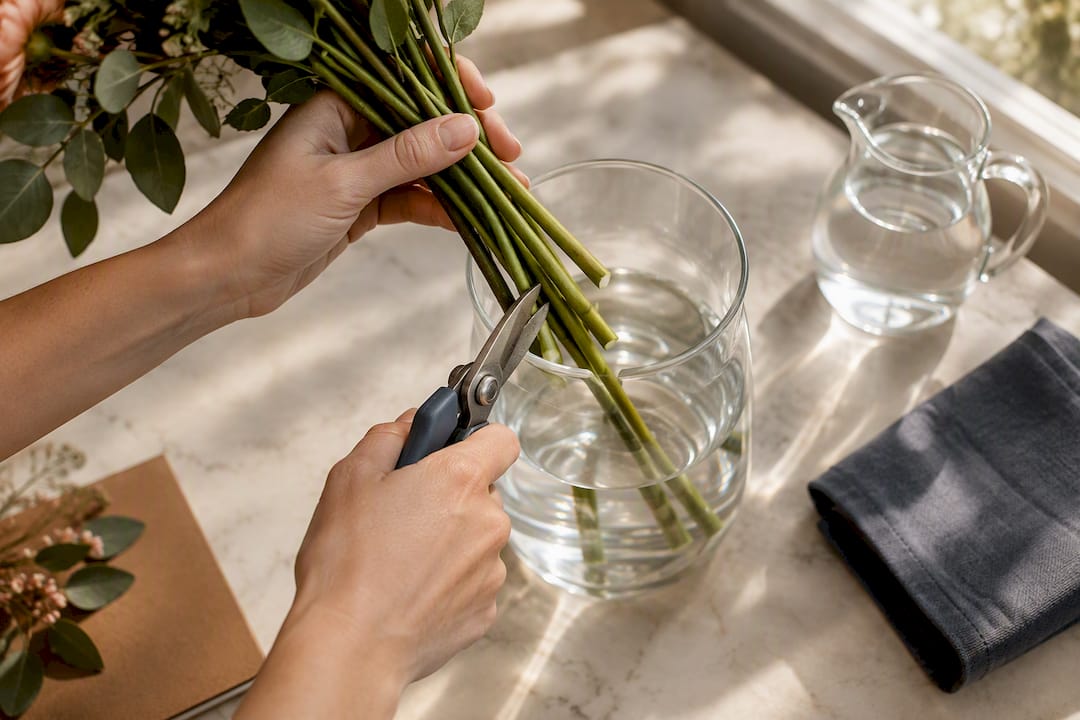
Imported flowers need more deliberate handling because they’ve already been chemically supported through a longer transit window. Preservative treatments applied before shipping can mask dehydration, so an imported stem might look sturdy on delivery day and then decline sharply 48 hours later once those treatments wear off. Re-cutting the stem, using flower food consistently, and keeping the arrangement away from heat sources matters more here, not less.
Both types benefit from cool room temperatures and indirect light, but imported flowers are more sensitive to temperature swings because refrigerated transit conditioned them to a narrower comfort zone. A local bouquet sitting near a sunny window might wilt a day early. An imported one exposed to the same heat can collapse within hours.
One practical rule: whichever type you buy, change the water every other day and re-cut the stems each time you do. It costs thirty seconds and consistently adds two to three days of vase life regardless of where the flowers started their journey.
Author’s Takeaway
The freshness gap between local and imported flowers is real and measurable, not marketing spin. My honest read: buy local whenever the occasion allows it, save imported stems for genuine gaps in variety or season, and always ask your florist where the flowers actually came from before you pay.
— Ovannes
Get Locally Sourced Arrangements With Same-Day Delivery
Some florists are built around the trade-off this article just walked through: locally-sourced, naturally-grown blooms instead of stems that spent a week in transit. That means fresher arrangements with better fragrance and longer vase life, backed by timely delivery within a local area, so the gap between harvest and doorstep stays short.

Whether you need a classic rose arrangement, seasonal peonies, or a sympathy design for a difficult moment, every piece is handcrafted to order rather than pulled from imported cold storage. Custom arrangements and video message add-ons are available too, for anyone who wants the delivery to feel personal. Place your order today and see the freshness difference in the first bouquet that arrives.
Sources
- Environmental Benefits of Local Cut Flower Production | Department of Horticultural Science
- Sustainable flowers (event greening resources)
- Sourcing more sustainable flowers - FoodPrint
- EPA greenhouse gas equivalencies calculator
FAQ
Is It Better to Order From a Local Florist?
For freshness, fragrance, and vase life, yes, a local florist using locally-sourced blooms typically beats imported commodity stems delivered through a big-box chain. Local sourcing also cuts down the transit time that causes imported flowers to look fine on delivery but decline fast within days.
What Is the 3:5:8 Rule for Flowers?
The 3:5 rule is a design guideline florists use for arrangement proportions, based on odd-numbered groupings of three or five stems to create visual balance. It applies to how a bouquet is composed rather than to sourcing, so it works the same whether the stems are local or imported.
Why Are Some Grocery Store Flowers So Cheap?
Large retail chains buy imported commodity flowers in massive volume directly from overseas growers, which drives per-stem cost down even after air freight and cold-chain expenses. That scale is exactly what keeps prices low, but it also means those stems have usually traveled days to a week before reaching the shelf.
Where Do Wholesale Club Roses Typically Come From?
Roses sold through large wholesale retailers are almost always imported, most commonly from South American growing regions like Colombia and Ecuador, given that at least 80% of U.S. cut flowers come from abroad. They’re bred for shipping durability, which is part of why they often lack the fragrance of a locally grown rose.