

Send florist-delivered sympathy flowers to the funeral home in time for the visitation or service, unless the obituary specifically asks for donations or “no flowers.” Funeral directors handle placement on-site, so a professional delivery causes zero disruption to a grieving family. Emily Post’s etiquette guidance backs florist delivery over hand-carrying arrangements yourself.
- Default action: Order from a florist, addressed to the funeral home, unless told otherwise.
- Check first: Read the obituary or call the funeral home if the wording is unclear.
- Exception: “Donations preferred” or “family flowers only” means skip the arrangement and give another way.
Key Takeaways
Following the obituary’s wishes and letting a florist handle timing and placement is the single most reliable rule in funeral flower etiquette.
| Point | Details |
|---|---|
| Check the obituary first | Follow any request for donations or “no flowers” before ordering anything. |
| Match scale to relationship | Immediate family covers large tributes; coworkers and acquaintances should send modest arrangements. |
| Deliver well in advance to give funeral home staff time to place arrangements before guests arrive. | Give funeral home staff time to place arrangements before guests arrive. |
| Keep the card short | A brief, sincere line addressed to “The Family of [Name]” works for nearly any relationship. |
| Order through a trusted florist | Lafleurel handles same-day delivery and coordination with the funeral home so families aren’t burdened with logistics. |
Table of Contents
- Types of Funeral Flower Arrangements and Who Sends Them
- How Much Should You Send Based on Your Relationship?
- Where and When to Send Funeral Flowers
- What to Write on a Funeral Flower Card
- How Much Do Funeral Flowers Typically Cost?
- Handling “In Lieu of Flowers” and Avoiding Common Mistakes
- Do Funeral Flower Customs Change Across Religions?
- What Happens to Funeral Flowers After the Service?
- Sources
Types of Funeral Flower Arrangements and Who Sends Them
Not every arrangement fits every relationship, and picking the wrong scale can feel awkward for everyone involved. Here’s how the main categories break down:
- Casket spray. A large arrangement draped over the casket, almost always ordered by immediate family only.
- Standing spray or wreath. Displayed on an easel near the casket or entrance; appropriate for close family, lifelong friends, or a workplace pooling funds together.
- Sympathy bouquet or vase arrangement. A smaller, self-contained piece sent to the home; this is the safe, versatile choice for friends, coworkers, and distant relatives.
- Living plant. A peace lily or similar potted plant that outlasts the service, often chosen when the sender wants something the family can keep.
- Floral tribute. A themed piece (a cross, heart, or symbol tied to a hobby or faith) usually reserved for family or very close friends.
- Tied sheaf. A loosely gathered, hand-tied bundle sometimes carried during a graveside service rather than displayed on a stand.
Classic whites and calm neutral tones read as respectful defaults. Save themed or highly personal designs for relationships where you know the family will recognize the gesture.
How Much Should You Send Based on Your Relationship?
Your connection to the deceased or their family should drive the size and formality of what you send, not the other way around.
- Immediate family typically covers the casket spray and any large standing tributes near the service itself.
- Close friends and extended family can send a substantial standing spray or a personalized floral tribute without it feeling excessive.
- Coworkers and acquaintances usually do better pooling into one group arrangement or sending a modest bouquet directly to the family home.
- Group cards should list names simply: “Your Friends at Marlowe & Co.” or “The Tuesday Book Club” reads cleaner than ten individual signatures crammed onto one ribbon.
- When you’re not sure where you fall, send something modest with a warm handwritten note. Understated is never the wrong call; oversized is harder to walk back.
Where and When to Send Funeral Flowers
Get the destination and timing right, and your flowers become a quiet comfort. Get it wrong, and they become one more thing staff has to manage during an already difficult day.
- Service happening soon: Send to the funeral home so it arrives before the visitation begins.
- Late notice or no service details yet: Send to the family’s home instead.
- Memorial scheduled weeks or months out: Coordinate timing with the family directly, since a delayed gathering changes when flowers actually do the most good.
Devlin Funeral Home’s etiquette guidance recommends having your florist deliver arrangements at least two to three hours before the service starts, giving staff enough time to place everything without last-minute scrambling. If the obituary says nothing about flowers, a call to the funeral home clears up any confusion in under a minute.
Cremation has changed a lot of this timing math. NFDA statistics show cremation now accounts for a majority of dispositions nationally, and many families hold a memorial weeks or even months after the death. When that’s the case, sending to the home right away, then again around the memorial date, often lands better than waiting.
What to Write on a Funeral Flower Card
The card matters more than people think, but it doesn’t need to be elaborate. Short and sincere beats long and searching for the right words every time.
- From family: “With deepest sympathy and love, always in our hearts.”
- From a close friend: “Thinking of you and holding you close during this difficult time.”
- From a coworker or acquaintance: “With heartfelt condolences from all of us at [company].”
- For a public tribute ribbon: Keep it to a name or short phrase, never a paragraph.
Address the card to “The Family of [Full Name]” when you’re not certain who will read it first. Ribbons on standing sprays should stay brief since they’re viewed by many people, not just the immediate family.
Pro Tip: Save the longer, more personal message for a private note delivered separately, and let the flower card stay short and public-friendly.
How Much Do Funeral Flowers Typically Cost?
Pricing scales with both the arrangement type and your relationship to the family, and there’s no rigid formula here, just reasonable ranges people tend to land in.
- Modest sympathy bouquet: A smaller vase arrangement sent to the home, fitting for coworkers or distant acquaintances.
- Medium arrangement: A step up in size and flower count, common from close friends or extended family.
- Large standing spray: The biggest investment, typically reserved for immediate family or a pooled group gift from a workplace.
If the obituary requests donations instead, follow that request rather than defaulting to a big arrangement out of guilt.
Handling “In Lieu of Flowers” and Avoiding Common Mistakes
When an obituary requests donations or says “no flowers,” that instruction exists for a real reason, often cost, space, or a family’s personal preference, so respect it. Funeral confirms a medium, calm-colored arrangement is the safest default only when nothing is specified at all.
- Donate to the named charity and send a brief personal note explaining what you gave.
- Never hand-carry flowers into a service; let a florist deliver ahead of time instead.
- Skip oversized tributes at small, private gatherings where they’ll feel out of place.
- Ask your florist to avoid heavily scented lilies in tight chapel spaces with older or sensitive guests.
- Don’t send flowers to someone’s workplace if the death hasn’t been shared publicly yet.
A meal, an offer to help with errands, or a living plant all work as respectful substitutes when flowers aren’t the right move.
Do Funeral Flower Customs Change Across Religions?
Flower customs vary more by faith and community than most people realize, and assuming one standard applies everywhere is one of the more common missteps.
- Jewish funerals: Flowers are generally not customary. A donation to a charity in the deceased’s memory, or bringing a meal to the family during shiva, is usually preferred.
- Muslim funerals: Practices vary by community and country of origin, so flowers may or may not be appropriate; a quick check with the family avoids missteps.
- Other communities: Some cultures favor specific colors or avoid flowers with certain scents or ties, so local custom matters more than a general rule.
When you’re not sure, call a family member or the funeral home directly. It takes one short conversation, and it saves you from a well-meaning gesture landing the wrong way. A thoughtful backup, a home-cooked meal, a grocery gift card, or a donation, works in nearly every tradition.
What Happens to Funeral Flowers After the Service?
Most funeral homes and crematoria clear arrangements within 24 to 72 hours after the service ends, so your flowers won’t sit untouched for weeks. Families often take home the pieces that mean the most to them, and many funeral homes will offer to donate remaining arrangements to a hospice, nursing home, or hospital if the family doesn’t want to keep everything.

If you’re placing flowers directly at a graveside, check with the cemetery first. Some sites have strict rules on containers, timing, and removal, and a call ahead prevents your tribute from being cleared out before anyone sees it.
Why Florist Delivery Takes the Burden Off Families
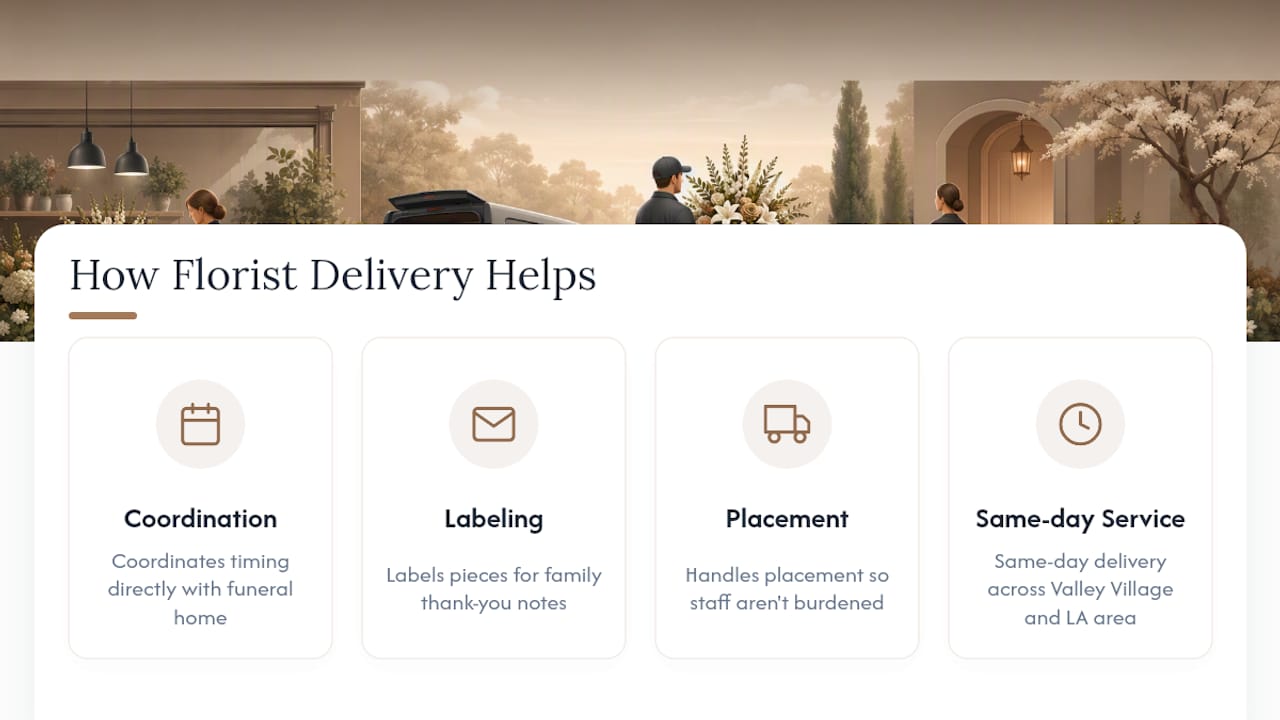
A good florist does more than arrange stems. They coordinate directly with the funeral home on timing, label each piece so the family can send proper thank-you notes later, and handle placement so nothing falls to already-overwhelmed staff. That coordination is exactly why Emily Post’s guidance points senders toward professional delivery over hand-carrying.
Lafleurel builds every sympathy order around that same logic: handcrafted arrangements, locally sourced blooms, and same-day delivery across Valley Village, CA and the surrounding Los Angeles area, so a last-minute need never becomes a logistical problem for the family.
A Note From Lafleurel on Sending With Care
We’ve handled enough sympathy orders to know that families remember who showed up, not how much was spent. What matters is respecting the obituary’s wishes, choosing something calm and well-made, and trusting a florist to get the details right so the family doesn’t have to think twice.
— Ovannes
Placing a Sympathy Order Without the Guesswork
Ordering funeral flowers gets simple once you have four details ready: the delivery address (funeral home, house of worship, or family residence), the service date and time, how the card should be addressed, and any scent or pet-safety restrictions the household needs. Lilies are a classic sympathy choice, but they’re toxic to cats, so mention pets in the household when placing your order.

Lafleurel’s Quicksand Beige Roses Arrangement works well as a neutral, respectful default when you don’t know the family’s preferences, and the Peonies Bouquet suits a smaller, personal delivery to the home. For arrangement styles and general planning, this guide to funeral packages is a useful companion resource. When you’re ready, visit Lafleurel’s Valley Village florist page to check same-day availability and place your order with delivery timing handled for you.
Sources
- Funeral
- Sympathy flowers — Emily Post
- Understanding the etiquette of traditional funeral flowers — Devlin Funeral Home
- NFDA — Statistics