

“I’m so sorry about your mom. She always made me laugh, and I’m bringing dinner by on Thursday.” That’s it. Name the loss, honor one thing about the person, offer something specific. Everything else in this guide is just variations on that same three-part structure, tuned for who you’re writing to and how well you knew them.
TL;DR:
- Including a specific memory about the deceased makes the message more heartfelt and helps the recipient feel genuinely supported.
- Offering concrete assistance, such as bringing dinner or helping with errands, is more meaningful than vague promises to help.
- Short, sincere messages are effective for acquaintances, while longer, personal notes are appropriate for close friends and family.
- Avoid common mistakes like minimizing loss with phrases such as “at least” or “they are in a better place,” which can feel dismissive.
- Matching the tone of flowers to the message enhances the gesture, with simple bouquets for brief notes and larger arrangements for close relationships.
Table of Contents
- What to write on a sympathy card, step by step
- Short, copy-ready sympathy card messages
- Sympathy messages by relationship and situation
- What not to say in a sympathy card
- How to address and sign a sympathy card
- When to send a sympathy card and how to follow up
- Why a handwritten note still matters
- Where the usual advice on sympathy cards falls short
- Pair your card with flowers that match its tone
- Sources
- FAQ
What to write on a sympathy card, step by step
The formula behind every good sympathy message has three or four moving parts: name the loss (use the person’s name when you can), mention one memory or quality, offer a specific kind of help, and close with warmth. That’s the whole template. Funeral recommends this exact structure because it forces you past generic condolence card wording and into something the recipient will actually remember reading.
Here’s how each piece works in practice:
- Name the loss. “I was so sorry to hear about Robert’s passing” beats “I heard the news” every time.
- Honor one memory or quality. One sentence is plenty. “He always had a joke ready, even on bad days” says more than three paragraphs of vague praise.
- Offer something specific. Not “let me know if you need anything.” Say what you’ll actually do.
- Close with warmth. “Thinking of you,” “With love,” or simply “Here for you” all work.
Length depends on the relationship, not the occasion. A coworker or acquaintance can get two sentences. A close friend or family member deserves a fuller paragraph, ideally with a real memory attached, according to KindSympathy’s guidance on matching message length to closeness.
Three quick examples showing the formula at work:
For a close friend: “I keep thinking about your dad’s laugh and how he’d tell that same fishing story every Thanksgiving. I’m so sorry, Sarah. I’m bringing over food Saturday, no need to plan anything.”
For a coworker: “So sorry for your loss. Marcus was always the first to help a new hire feel welcome. Thinking of you and your family this week.”
For a neighbor: “I was sad to hear about your mother. She always waved from the porch and asked about the kids. Please let me know if you need anything picked up from the store.”
Pro Tip: Write the memory line first, before the rest of the message. It’s the hardest part to fake and the easiest part to get wrong if you write it last and rush it.
Short, copy-ready sympathy card messages
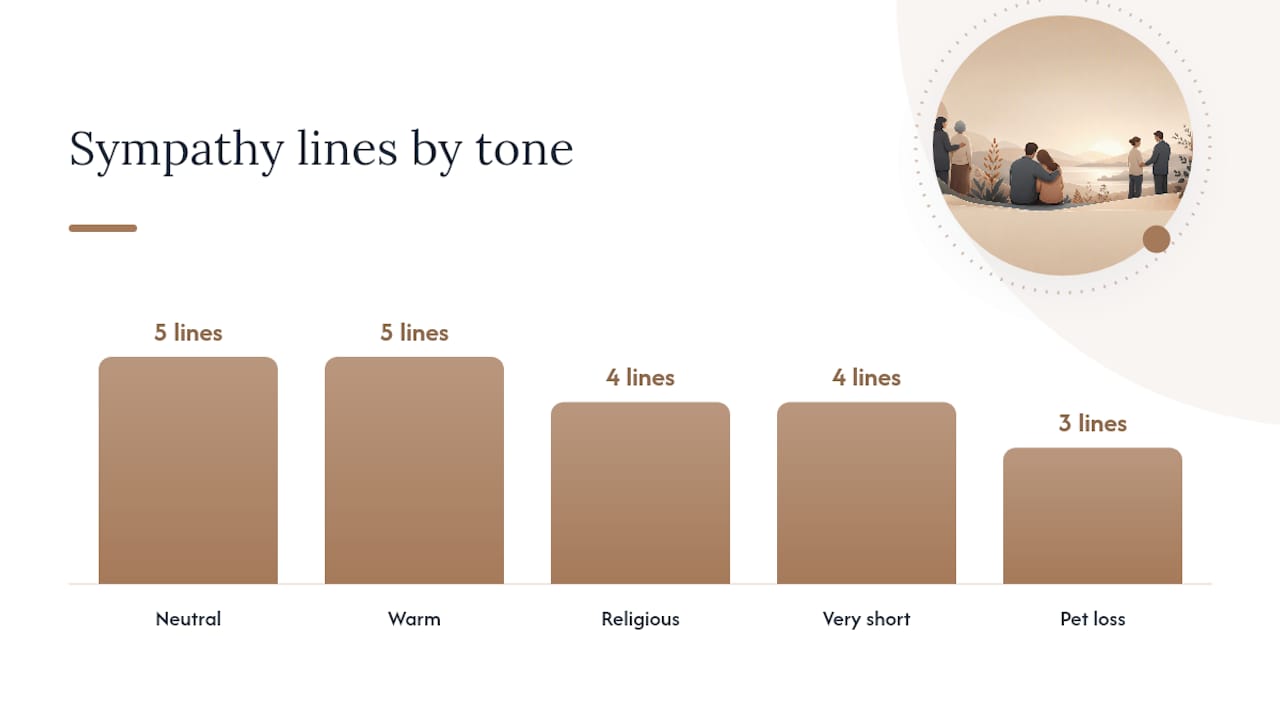
Sometimes you just need a line, not a paragraph. Below is a swipe file organized by tone, so you can grab something that fits the relationship without overthinking it.
Neutral, for coworkers, acquaintances, or distant relatives:
- “Thinking of you during this difficult time.”
- “My deepest condolences to you and your family.”
- “Wishing you comfort and peace in the days ahead.”
- “So sorry for your loss. Sending strength your way.”
- “Holding you in my thoughts this week.”
Warm, for close friends or family:
- “There’s nothing I can say to make this easier, but I’m here for you, always.”
- “Your dad was one of a kind, and I’m going to miss him too.”
- “I’m so sorry. I loved her laugh and I’ll never forget it.”
- “Grieving with you today and every day after.”
- “You don’t have to go through this alone. Call me anytime, day or night.”
Religious phrasing, when appropriate for the recipient:
- “Praying for peace and comfort for your family.”
- “May God’s grace surround you in the days ahead.”
- “Holding you in prayer as you grieve this loss.”
- “May you find comfort in your faith and in those around you.”
Pet loss:
- “I’m so sorry about Max. He was such a good boy, and your home won’t feel the same without him.”
- “Losing a pet is losing a family member. Thinking of you.”
- “Sending love as you grieve your sweet companion.”
Very short lines for flower enclosures, where space is tight and sympathy flowers etiquette favors brevity:
- “With deepest sympathy.”
- “Thinking of you and your family.”
- “In loving memory.”
- “With love and condolences.”
Match the tone to the setting. A neighbor or coworker rarely needs a religious line unless you know their faith well, and a very close friend often wants more than a neutral card message. When in doubt, one sincere sentence beats three generic ones.
Sympathy messages by relationship and situation
Who you’re writing to changes everything about tone, length, and what’s appropriate to mention. Here’s how condolence messages for flowers and cards shift by relationship.
For the loss of a parent: “I’m so sorry about your father. He was always so proud of you, and it showed every time he talked about your work.” Avoid comparing losses or saying “at least he lived a long life.” Offer to help with a specific task, like sitting with them during calls to the funeral home.
For the loss of a spouse or partner: “There are no words for what you’re going through. He loved you more than anything, and that was obvious to everyone who knew you two.” Keep the focus on the couple’s bond rather than logistics. A specific offer here matters more than usual: “I’ll come by Wednesday evening so you’re not alone.”
For the loss of a sibling: “I’m heartbroken for you. Growing up with a sibling like her is something no one else can replace.” Skip anything that minimizes the sibling bond as “just” a sibling. Offer practical help with things like childcare or errands.
For the loss of a child: This one calls for restraint. “There are no words. We are thinking of you and are here for whatever you need, whenever you need it.” Never try to explain or rationalize this loss. A single sincere line does more good than a long paragraph.
For a friend: “I keep replaying our last conversation with your mom and how much she made me laugh. I’m bringing coffee by Friday morning.” Include a real memory if you have one. It’s the difference between a card that gets read once and one that gets kept.
For a coworker: “So sorry to hear about your loss. Take the time you need. We’ve got things covered here.” Keep it brief and avoid workplace logistics talk unless you’re the manager.
For an acquaintance or neighbor: “Thinking of you and your family during this time.” Short is appropriate and expected. Don’t reach for a memory you don’t actually have.
For pet loss: “Your dog was such a sweet presence on our street. I’m so sorry for your loss.” Treat it with the same seriousness as any other loss. Pet grief is real grief.
What not to say in a sympathy card
Certain phrases show up constantly in condolence card wording, and nearly all of them backfire. Grammarly’s guidance on sympathy writing flags comparisons of grief and forced silver linings as two of the most common mistakes people make under pressure.
Pro Tip: If a sentence starts with “at least,” delete it. Almost nothing that follows helps.
- “At least she lived a long life.” This minimizes the loss. Instead write: “She lived a full life, and I’m so sorry it’s over.”
- “They’re in a better place now.” This assumes shared belief and can feel dismissive. Instead write: “I’m thinking of you and holding onto the good memories with you.”
- “I know exactly how you feel.” No two griefs are the same, and this shifts focus to you. Instead write: “I can’t imagine how hard this is, but I’m here.”
- “Everything happens for a reason.” This can feel like an excuse for tragedy. Instead write: “This is so unfair, and I’m so sorry.”
- “Let me know if you need anything.” Open-ended offers rarely get used. Instead write: “I’m dropping off dinner Tuesday, no need to plan anything.”
How to address and sign a sympathy card
- Address the card to the person you knew best, or to “the [Last Name] Family” if you knew the whole household. If you only knew one relative, Emily Post’s etiquette guidance recommends addressing the closest relative directly rather than the whole family.
- For group or office cards, sign as the group (“The Marketing Team”) alongside individual signatures if space allows.
- If children read the card, keep language simple and avoid graphic detail about the death itself.
- Close with something warm rather than purely formal: “With love,” “Thinking of you,” or “Here for you” all read as sincere without feeling stiff.
- Sign with your full name if the recipient may not immediately place a first name alone, especially for coworkers or distant acquaintances.
When to send a sympathy card and how to follow up
Sending a card before or around the time of the service is standard, but a card mailed two or three weeks later is just as appropriate, especially once the initial rush of visitors and casseroles has stopped. Both timings work.
The follow-up matters more than people realize. A short note a month or two later, something like “Still thinking of you and your dad. Want to grab coffee this week?” often lands harder than the first card, because it arrives after everyone else has gone quiet.
Why a handwritten note still matters
A heartfelt handwritten note carries more weight than a pre-printed card alone, according to Emily Post’s etiquette guidance, which notes that handwritten lines are often saved and reread long after the funeral. If you’re sending a printed card, add at least one handwritten sentence naming something specific about the person who died.
Flowers pair naturally with that written note. Emily Post’s sympathy flowers etiquette suggests scaling the arrangement to the relationship: a modest bouquet for an acquaintance, something larger for close family. A short enclosure line like “With deepest sympathy” works well tucked into a hand-tied bouquet, a blooming plant, or a standing tribute piece.
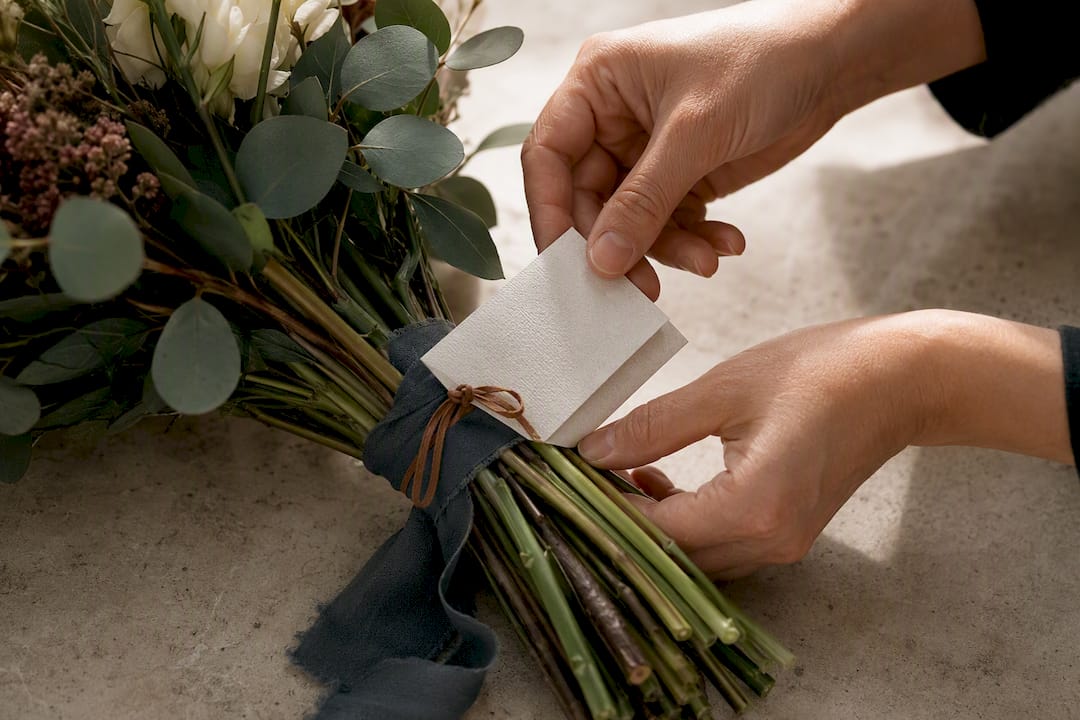
If a keepsake feels more fitting than flowers for certain relationships, a short engraved message on a memorial item can carry the same sentiment in a different form, and choosing wording that fits an engraved keepsake follows many of the same rules as card writing: short, specific, sincere.
Where the usual advice on sympathy cards falls short
Most sympathy card guides hand you a list of forty generic lines and call it done. The problem isn’t a shortage of phrases. It’s that people freeze up trying to pick the “right” one instead of trusting a simple structure that works regardless of what specific words fill it in.
The overlooked piece is the specific offer of help. Nearly every guide tells you to “be there” for someone, but vague offers put the burden back on a grieving person to ask, which they rarely do. A concrete offer like a named day and task removes that burden entirely, and it’s the single most actionable thing you can put in a card that a generic condolence line can’t match.
The other thing conventional advice underplays: length is not a measure of sincerity. A two-sentence card for a coworker and a full paragraph for your best friend can both be equally meaningful, because they’re each matched to the relationship. Writing more than the relationship calls for often reads as performative rather than caring. Match the message to the person, offer something specific, and skip the phrases that minimize grief. That’s most of what this topic actually requires.
— Ovannes
Pair your card with flowers that match its tone
Once the words are written, the arrangement you send alongside them should match the tone of the card, not overshadow it. A simple bouquet suits a short, warm note to a coworker or neighbor. A larger arrangement or standing tribute fits when you’re writing to close family and want the gesture to carry as much weight as the message.

Arrangements are crafted by hand using locally sourced, naturally grown flowers, aiming to preserve freshness even with same-day delivery. The Sympathy and Funeral Designs collection includes options sized for everything from a quiet acknowledgment to a full family tribute, and same-day delivery within Valley Village and the surrounding Los Angeles area means you’re not scrambling to time it around a service. A video message option is available to accompany the arrangement, providing additional personalization beyond a written card. Browse the collection and pick the size that matches what you wrote.
Sources
- How to write a sympathy card message | Grammarly
- Sympathy notes and letters — Emily Post
- Funeral
- What to Write in a Sympathy Card — KindSympathy
FAQ
What are nice words to put in a sympathy card?
Simple, sincere lines work best: “Thinking of you,” “Sending love and strength,” or “So sorry for your loss.” Adding one specific memory or quality about the person turns a generic line into something meaningful, per KindSympathy’s guidance on tailoring length and detail to the relationship.
What do you say instead of “sorry for your loss”?
Try “I’m thinking of you” or “I’m here for you, whatever you need,” paired with one specific offer of help. Naming a memory of the person, like “She always made everyone laugh,” gives the message more weight than a stock phrase alone.
What’s the best condolence message?
The best message names the loss, honors the person with one memory or quality, and offers something specific, following the structure outlined by Funeral.com’s etiquette guidance. There isn’t one universal “best” line since tone should match your relationship to the bereaved.
What’s a good short sympathy quote?
“With deepest sympathy” and “In loving memory” both work well for flower enclosures or brief cards. For something slightly warmer, “Holding you in my thoughts” fits most relationships without overstepping.
Does Lafleurel offer sympathy flower arrangements?
Yes, Lafleurel’s Sympathy and Funeral Designs collection includes handcrafted arrangements made with locally sourced flowers, with same-day delivery available in Valley Village and the surrounding Los Angeles area. Pricing details are listed on the collection page.