

Yes, fresh handcrafted bouquets can be genuinely long lasting. Most well-conditioned arrangements hold up for 7 to 14 days, and some varieties push past 18 days when harvest timing, professional conditioning, and home care all line up. That 7-day figure is the industry’s standard baseline, with many varieties reaching 10 to 14 days under proper handling from cutting to vase. Lafleurel conditions every stem before it leaves the shop and runs same-day delivery across Valley Village and the surrounding Los Angeles area, which closes the gap between “fresh at the shop” and “fresh in your living room.”
Key Takeaways
Fresh handcrafted bouquets reach their full 7 to 14 day vase-life potential only when professional conditioning at the shop is paired with consistent water changes and stem recuts at home.
| Point | Details |
|---|---|
| Expect 7 to 14 days | Baseline vase life is about 7 days, with many varieties lasting 10 to 14 days under proper care. |
| Change water every 2 to 3 days | Wash the vase, recut stems at 45 degrees, and refresh flower food each time. |
| Avoid ethylene sources | Keep bouquets away from ripening fruit, ovens, and heating vents to slow aging. |
| Buy at the just-opening stage | Firm stems and unopened buds signal a longer remaining vase life than fully bloomed flowers. |
| Choose conditioned bouquets | Lafleurel conditions every stem and includes flower food and care tags with same-day delivery. |
Table of Contents
- How Long Should Long Lasting Flowers Actually Last?
- Why Do Bouquets Wilt Early? Five Common Causes
- What to Check When Buying for Longevity
- What Professional Conditioning Actually Involves
- Your At-Home Routine for Longer Lasting Flowers
- Special Care for Common Troublemakers
- Do Home Remedies Like Vinegar or Sugar Actually Work?
- Handling Your Bouquet Right After Purchase
- Long Lasting Flowers: What Actually Moves the Needle
- Order Conditioned Bouquets With Same-Day Delivery
- Frequently Asked Questions
- Sources
How Long Should Long Lasting Flowers Actually Last?
Seven days is the floor, not the ceiling. Roses, alstroemeria, and carnations regularly stretch to 10 or 14 days with clean water and a quick recut every few days. Certain specialty stems, chrysanthemums among them, can exceed 18 days under ideal conditions: cool room temperature, minimal handling, and consistent water changes.
A few variables decide where your bouquet lands on that spectrum:
- Flower variety — some species are simply built tougher (carnations, alstroemeria) while others are fragile by nature (peonies, hydrangeas).
- Harvest stage — stems cut and sold in the just-opening stage outlast ones bought fully bloomed.
- Pre-delivery conditioning — bucket-holding, hydration treatments, and cool storage before the bouquet ever reaches you.
- Transport temperature — a bouquet that rode in a hot car loses days before it’s even unwrapped.
- At-home maintenance — water changes, stem recuts, and where you place the vase.
The global cut-flower trade runs on that 7-day consumer expectation, and it’s a large trade: the ornamentals industry moves more than $130 billion a year, with postharvest researchers actively testing new preservation technology to push those numbers higher.
Why Do Bouquets Wilt Early? Five Common Causes
Most premature wilting traces back to a handful of preventable problems, and understanding them changes how you shop and how you care for flowers once they’re home.
Bacterial buildup is the biggest culprit. Any foliage sitting below the waterline decays and feeds bacteria that clog the stem’s vascular system, blocking water uptake even though the vase looks fine. Ethylene gas is the second problem: it’s a natural plant hormone that accelerates aging, and it’s released by ripening fruit, some vegetables, and even certain flowers themselves. Postharvest physiology research consistently points to ethylene as one of the strongest accelerators of cut-flower aging, which is why florists keep bouquets away from fruit bowls in the cooler.
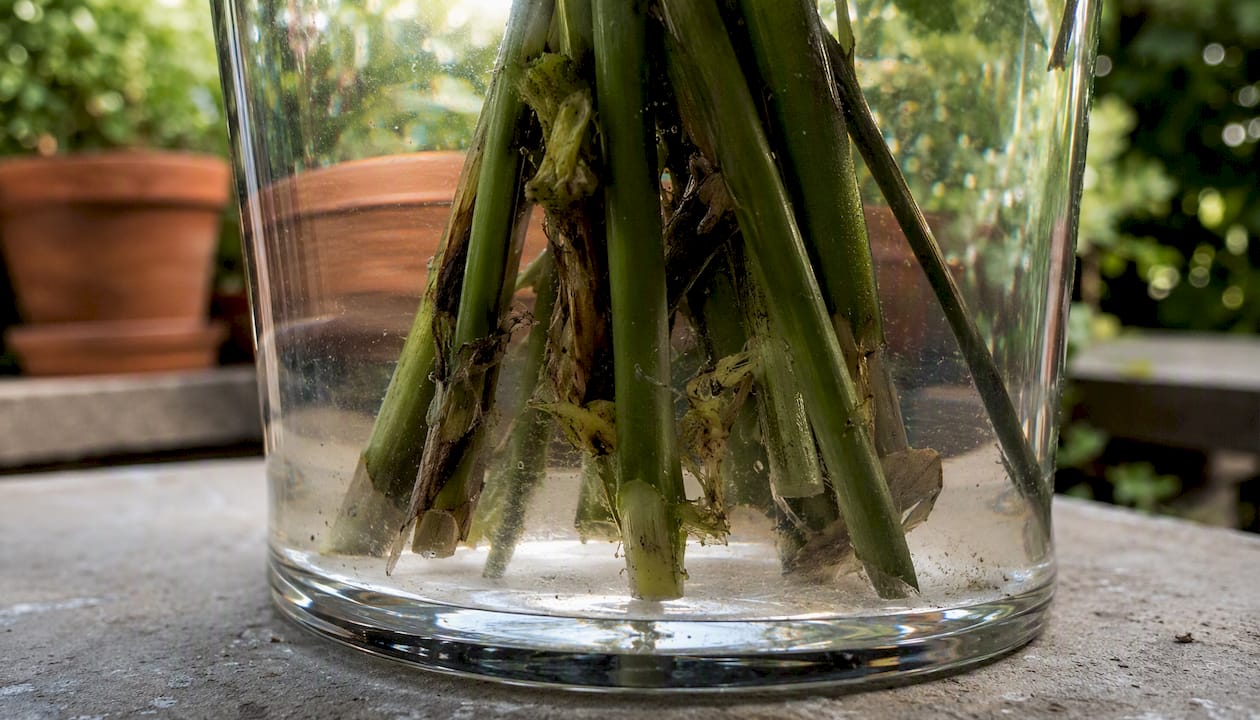
Heat, direct sun, and drafts round out the environmental threats, since all three speed up transpiration and force the stem to work harder than it can keep up with. Then there’s harvest stage: a stem cut too late or never properly conditioned starts its countdown before you’ve even brought it home. Finally, water chemistry matters more than people assume. The wrong pH or straight tap water without treatment can slow uptake, and a few species carry their own quirks, like daffodil sap, which is mildly toxic to other flowers sharing the same water.
Pro Tip: If your bouquet includes daffodils or narcissus, ask whether they were conditioned separately before mixing. Their sap can shorten the life of everything else in the vase if it isn’t handled first.
What to Check When Buying for Longevity
A little scrutiny at the point of purchase does more for vase life than almost anything you’ll do at home. Look for these signals before you commit to a bouquet:
- Firm stems with no sliminess — a stem that feels soft or slippery is already breaking down.
- Just-opening buds, not fully bloomed flowers — stems bought at the just-opening stage consistently outlast ones sold fully open.
- Healthy foliage — no yellowing, no fuzzy gray mold, no wilting leaves.
- Evidence of conditioning — ask whether stems were rehydrated, bucket-held, or given an acid pulse before arranging.
- Flower food included — a legitimate florist sends a packet with every arrangement, not an afterthought.
- Cool, careful transport — stems that traveled in water or in a florist’s cooler beat ones that sat loose in a box.
A bouquet like the Red Roses Hand Held Bouquet gives you an easy benchmark: firm stems, tight buds, and full green foliage on arrival tell you the conditioning was done right. If a florist can’t answer basic questions about how the stems were handled before your order left the shop, that’s worth noting.
What Professional Conditioning Actually Involves
Conditioning is the behind-the-scenes work that decides whether a bouquet has 5 days left in it or 12. It starts the moment stems arrive at the shop: florists rehydrate them, trim away damaged foliage, strip anything that would sit below the waterline, and place stems in a holding solution or walk-in cooler to stabilize before arranging begins.
The full professional process typically includes:
- Sanitary processing of stems and buckets to prevent bacterial contamination.
- Citric-acid pulses or hydrating dips for stems prone to wilting or air blockage.
- Commercial holding solution formulated for the specific flower variety.
- Refrigerated storage between processing and delivery.
- Careful packing that keeps stems upright and hydrated in transit.
These steps mirror what extension specialists describe as proper harvest-to-vase handling: cool harvest timing, sharp clean tools, and immediate hydration in tepid water, followed by hours of bucket-holding before the flowers ever touch a design table.
When you order, it’s fair to ask your florist three things: Were the stems conditioned before arranging? Is flower food included with delivery? And how was temperature managed between the shop and your door? A florist confident in their process will answer all three without hesitation.
Your At-Home Routine for Longer Lasting Flowers
The first 30 minutes after your bouquet arrives set the tone for everything that follows. Here’s the timeline that actually moves the needle.
- First 30 minutes: Unwrap the bouquet gently and recut each stem at a 45-degree angle under tepid, running water. A fresh angled cut opens new vascular tissue for water uptake and prevents the flat, sealed-off cut that can form during transport.
- Strip and prep: Remove any leaves that would sit below the waterline once the stems are in the vase. Submerged foliage decays fast and feeds the bacteria that clog stems from the inside.
- Fill and feed: Use a clean vase and fill it with tepid water mixed with the commercial flower food packet included with your order. Those packets combine carbohydrates for energy, citric acid to acidify the water, and biocides to control bacteria at a dilution that’s already calibrated. Don’t guess at your own mix.
- First 24 to 48 hours: Keep the arrangement in a cool, shaded spot away from direct sun, heating vents, and the kitchen. Skip the fruit bowl entirely.
- Every 48 to 72 hours: Dump the water completely, wash the vase with hot, soapy water, recut stems at 45 degrees, and refill with fresh water and flower food. This single habit is the most reliable way to extend vase life across almost every flower variety.
- Ongoing: Pull any bloom that’s fading or dropping petals so it doesn’t accelerate decline in the rest of the arrangement.
Pro Tip: Tepid water between 80 and 110 degrees Fahrenheit helps most stems avoid air embolisms and hydrate faster in that first hour. Tulips and daffodils are the exception. Give bulb flowers cold water instead, since they keep growing after the cut and warm water pushes them to stretch and flop.
Follow this rhythm and you’re doing exactly what commercial growers recommend for the industry’s baseline 7-day expectation, minus the guesswork.
Special Care for Common Troublemakers
Mixed bouquets often include a few species that need individual attention, and knowing their quirks in advance saves you from an unpleasant surprise on day three.
Daffodils release a sap that shortens the life of other flowers sharing their water. Florists condition daffodils separately for 12 to 24 hours before mixing them into an arrangement, and if yours arrived pre-mixed, a quick water change on day one helps flush out any residual sap.
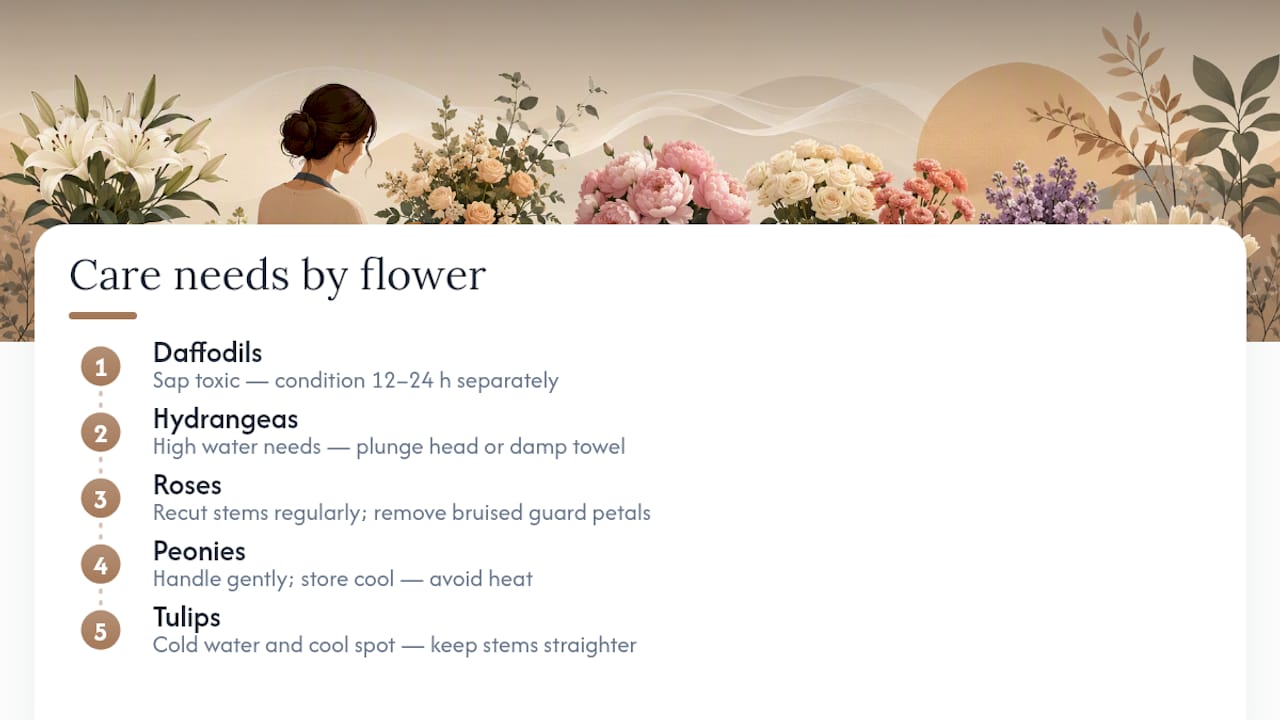
Hydrangeas drink more than almost anything else in a bouquet, and their big flower heads dehydrate fast. Plunging the whole head in cool water for a few minutes, or wrapping it in a damp paper towel overnight, revives a drooping hydrangea more often than people expect.
Roses need their stems recut regularly and any bruised guard petals removed. Watch for “bent neck,” where the stem folds just below the bloom. It usually means air got into the stem, so keeping the vase water level high prevents it.
Peonies bruise easily and wilt faster in heat, but they reward gentle handling and cool storage with some of the longest bloom windows in the business. The Peonies Bouquet is a good example of how much presentation depends on that careful pre-delivery handling.
Tulips keep growing after the cut, bending toward light and stretching in warm rooms. Cold water and a cooler spot in the house keep the stems straighter longer.
Do Home Remedies Like Vinegar or Sugar Actually Work?
Kitchen fixes for cut flowers have circulated for generations: a splash of vinegar, a spoonful of sugar, a drop of bleach, even a penny in the water. Some of these have real mechanisms behind them. Sugar acts as a carbohydrate source, similar to what’s in commercial flower food, and a small amount of bleach or vinegar can slow bacterial growth in the same way a biocide does. Research into preservative chemistry backs this up: sucrose, citric acid, and mild bactericides all show measurable effects on vase-life extension across many species, and slightly acidic water in the pH 3 to 4 range generally discourages microbial growth.
The catch is proportion. Commercial flower food packets are pre-measured to hit that balance precisely, combining the right ratio of sugar, acid, and biocide for the volume of water in a typical vase. A homemade mix is a guess. Too much bleach damages stem tissue. Too much sugar without an accompanying biocide can actually feed bacteria faster than it feeds the flowers. If you’ve run out of the packet that came with your bouquet, a small amount of white vinegar (about a tablespoon per quart) paired with a teaspoon of sugar is a reasonable stopgap, but it’s not a substitute for using the real thing when you have it.
The simplest rule: use the flower food that came with your arrangement first, every time. Save the DIY substitutes for when you genuinely have nothing else on hand.
Handling Your Bouquet Right After Purchase
The thirty minutes between pickup and vase matter more than most buyers realize, especially if you’re driving across Los Angeles traffic with fresh stems in the back seat.
Keep the bouquet upright during transport whenever possible, ideally still in its water sleeve or wrapped base rather than laid flat on a seat. A hot car is one of the fastest ways to undo careful conditioning, so if you’re running errands before heading home, keep the flowers out of direct sun and away from a hot dashboard. Air conditioning is fine. A trunk in July sun is not.
Once you’re home, don’t let the bouquet sit wrapped for hours “until later.” Every minute spent out of water after the stems were last cut is a minute the vascular system can start sealing itself off, making the eventual recut less effective. Unwrap it, recut the stems, and get them into water within the first 30 minutes if you can manage it.
If you’re transporting flowers for an event rather than home display, keep them in their original water source for as long as possible and only remove them from water at the very last stage of setup. Sudden temperature swings, like moving a bouquet from an air-conditioned car into outdoor heat for a ceremony, stress the stems more than steady conditions at either extreme. A short stop in a shaded, cool spot before final placement gives the flowers a chance to acclimate rather than shock.
Long Lasting Flowers: What Actually Moves the Needle
Most advice about cutting flower life focuses on the wrong lever. People fixate on home remedies and clever tricks, vodka in the water, aspirin, copper pennies, when the real determinants happen before the bouquet ever reaches a kitchen counter. Harvest timing, conditioning, and cold-chain handling account for more variance in vase life than anything a customer does at home. That’s not a knock on home care; it’s a fact about where the biggest gains are hiding.
The conventional wisdom oversells water additives and undersells the boring stuff: washing the vase, changing water on schedule, and recutting stems. Those three habits, done consistently every 2 to 3 days, do more than any home remedy ever will.
If there’s one thing buyers underestimate, it’s how much a good florist eliminates on your behalf. Conditioning at the shop can add days you’ll never have to fight for at home. That’s the real argument for buying from someone who takes the process seriously instead of treating flowers as a commodity grabbed off a cooler shelf.
Order Conditioned Bouquets With Same-Day Delivery
Every arrangement Lafleurel builds starts with locally sourced stems that go through the same conditioning process described above: rehydration, careful trimming, refrigerated holding, and a care tag with your specific flowers’ at-home instructions included at delivery. You’re not guessing at flower food ratios or wondering whether the roses were cut too late. That work is already done before the bouquet reaches your door.

Same-day delivery across Valley Village and the surrounding Los Angeles area means your flowers spend less time in transit and more time conditioned and cool, which is exactly the variable that determines whether you get 7 days or 14. If you want a bouquet built around genuine longevity, the Quicksand Beige Roses Arrangement and other rose-forward designs hold up especially well with the routine outlined above. Ready to order? Visit Lafleurel to check same-day availability in your area and get a conditioned bouquet on its way today.
Frequently Asked Questions
How often should I change the water in a bouquet? Every 2 to 3 days, along with a full vase wash and a fresh 45-degree recut on each stem.
Do I need to use the flower food packet, or can I skip it? Use it. Commercial flower food is calibrated with the right balance of sugar, acid, and biocide, and skipping it usually shortens vase life.
Can I ask my florist how the flowers were conditioned before delivery? Yes, and you should. A florist that conditions stems properly will describe their process without hesitation, including whether stems were bucket-held, hydrated, or cooled before arranging.
Why do some flowers in a mixed bouquet die faster than others? Species vary naturally in toughness, and some, like daffodils, release compounds that shorten the life of neighboring stems if not conditioned separately first.
Sources
- The Professional Florist’s Manual for the Care and Handling of Fresh-Cut Flowers and Foliage
- Extend vase life of your fresh flowers
- How to use flower food
- Ethylene and postharvest aging in cut flowers (postharvest physiology research)
- Selecting & caring for cut flowers